



Fact box









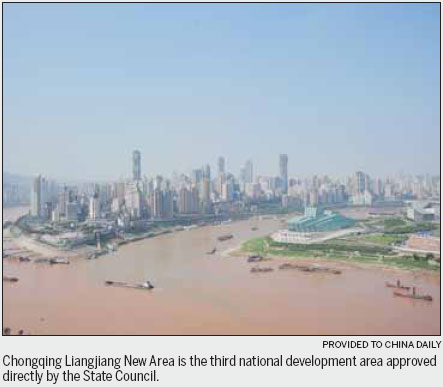
Liangjiang means "two rivers" in Chinese, and refers to the Yangtze River and Jialing River that converge at Chongqing at the head of Yuzhong peninsula, the heart of the municipality.
In June 2010, the State Council approved a 1,200-square-kilometer area across from the north bank of the peninsula as Liangjiang New Area, a pilot zone to test new policies, introduce foreign investment and drive future growth.
The district is the third state-level development area approved directly by the State Council after Shanghai's Pudong New Area and the Binhai New Area in Tianjin.
Liangjiang has been set five major missions: a pilot area for comprehensive urban-rural reform in the hopes of narrowing the gap between urban and rural areas; an inland base for advanced manufacturing and modern services; a regional financial and innovation center; an important door for openingup inland China; and a window for scientific development.
According to a 2012 development report, Liangjiang achieved annual GDP growth of 20.4 percent, outpacing the 20.1 percent recorded in Binhai, and Pudong's 10.4 percent, and far outstripping the national average of 7.8 percent. In the first half of this year, industrial output in the new area surged 35.1 percent year-on-year to hit 159.5 billion yuan ($26 billion; 19.3 billion euros), well above the city's average growth.
Electronic information, automobiles, high-end manufacturing, aviation and biomedicines have been identified as the region's five pillar industries. Finance, conferences, bonded zone and logistics are designed to be the four core functional areas for Liangjiang.
The region needs to attract about 100,000 highly skilled workers to sustain its development. Some 400,000 jobs will be on offer by 2015, according to Liangjiang's administration. Chongqing is home to 8 million migrant workers, half of them working in coastal cities. The local government is using every means to bring them back, including the construction of affordable housing projects and the provision of free training programs.
(China Daily Africa Weekly 11/29/2013 page16)


Today's Top News
- Public safety built into the social structure: China Daily editorial
- The power of reading as a bridge to knowledge, culture and development: China Daily editorial
- Bosch CEO shows confidence in China
- One-China principle remains widely recognized
- Tokyo gunning for changes in weapons export policy
- Dangers of bypassing ecology for economic gains


