



Silk Road inspires understanding









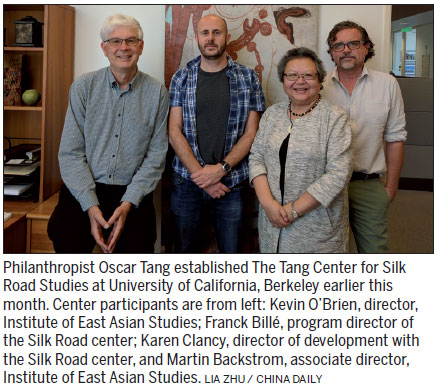
The popular image of the ancient Silk Road is one of a network of trade routes full of camel caravans and bustling bazaars. Now, thanks to a gift from a Chinese-American philanthropist, the recently launched Center for Silk Road Studies at University of California, Berkeley will go far beyond that image.
Understanding the Silk Road is important to modern people because it informs them who they are as humans, said Karen Clancy, director of development of outreach with the center.
"By doing research in the areas that have been there for thousands of years, we are able to bring new light to that history, to help people understand how those interactions affected people of that time," she explained.
Established earlier this month by a $5 million gift by Oscar Tang and his family, the Tang Center for Silk Road Studies, is the first institutionalized center of its kind in the US. It will promote research and teaching about the historical overland and maritime exchange networks commonly known as the Silk Roads that date back to the Han Dynasty (202 BC - 220 AD).
The historical Silk Road, with China at the eastern end, was for centuries central to cultural interaction through central Asia to the Mediterranean.
These areas are considered periphery, or the edge of everywhere else and other kinds of studies, but at the Silk Road center, the region is the center itself, no longer a periphery, said Kevin O'Brien, director of the Institute of East Asian Studies, which houses the Silk Road center.
For instance, Xi'an in the west of China becomes the heart of the center, rather than something on the edges of East Asian studies, he explained.
"So it's a good opportunity to give it due importance, when that part of the world was not periphery, but was very central to what globalization meant 1,000 or 2,000 years ago," said O'Brien.
East-West connections aren't new; globalization was happening 1,500 to 2,000 years earlier. Scholars believe by understanding the ancient cultural interactions, people can better understand the present world.
"I think people forget, or they don't know, there were these ties and exchanges going on. Part of the modern cultural identity in even a place like Beijing is in fact the historical circumstances of the Silk Road," said Martin Backstrom, associate director of the Institute of East Asian Studies.
During the Tang Dynasty when the Silk Road was flourishing, Chinese culture was greatly influenced by Persia and the Middle East. When camel caravans went into Chang'an (now called Xi'an), this process shaped Chinese culture, he said.
Understanding the ancient civilizations on the Silk Road requires expertise in various fields, like Buddhist studies, archeology, art history, languages and even science.
"Berkeley is a very logical place to open this center because we have the people who can support the center and we have students who are interested in studying this time period," said Backstrom.
Berkeley has expertise in many fields that are not well represented in the US, including medieval art history, Chinese archeology and some of the rare languages that were spoken and written on the manuscripts along the Silk Road, he said.
Berkeley is also a leader in Buddhist studies. Its PhD program is the only freestanding doctoral program in Buddhist studies in North America.
The multi-disciplinary collaboration provides "an opportunity to follow the flow from beginning to end, and not to be limited by borders that traditional area studies would silo people into just looking at just one country and losing interest," said O'Brien.
liazhu@chinadaily.com.cn
(China Daily USA 05/19/2017 page2)


Today's Top News
- Top economic body unveils temporary measures to control gas, diesel prices
- Xi inspects Xiong'an New Area in North China's Hebei
- Xi congratulates Thongloun on re-election as president of Laos
- Distorting Taiwan's history for political adventurism
- Lessons for Europe from China's growth
- Heavy rainfall expected to soak southern China


