



Putonghua push puts local dialect in spotlight









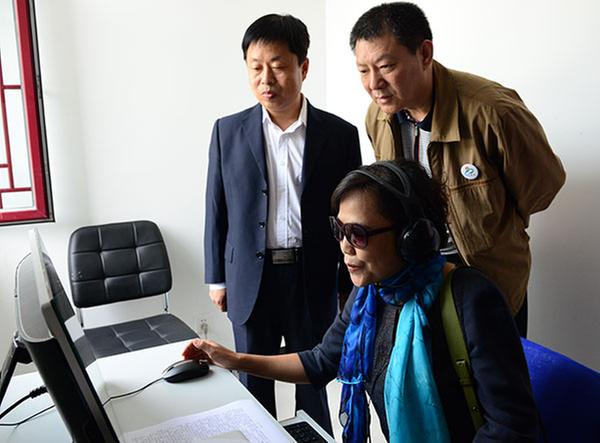 |
A woman uses a system designed to assess the accuracy of spoken Putonghua.[Photo by Huo Tengda for China Daily] |
Bedrock language
In 1953, the government dispatched a group of linguists to locations nationwide to record speech patterns, and to identify dialects that were easy to understand and could be standardized as the country's official spoken language.
Luanping was one of the places the experts visited.
They decided to use the local dialect as a main reference point for establishing a standard for official spoken Chinese, according to Wang Guoping, a senior historical researcher with the Luanping Committee of the Chinese People's Political Consultative Conference.
In 1955, China's standard spoken language was born. It was named Putonghua, or "common speech", because it was intended to be understood nationwide.
It was mainly based on the pronunciation used by speakers of northern dialects, especially the one spoken in Luanping.
According to the Luanping Mandarin Promotion Office at the county education bureau, the phonetic similarities between the Luanping dialect and modern Mandarin are striking.
"More than 95 percent of the sounds in the Luanping dialect are used in Putonghua," said Li Yanan, who works at the office, but is also a guide at a museum dedicated to both the local dialect and the official language.
For example, Putonghua has 22 initial consonants, while the Luanping dialect has 23, and 22 of them are the same as in Putonghua.
Despite the backing of expert opinion, Hao sometimes finds it difficult to convince people of the validity of her claim.
Even now, more than 60 years after the standard was introduced, many people don't understand why residents of Luanping, far from the capital, appear to speak fluent, clearly articulated Putonghua and sound more natural than Beijing natives, who are often regarded as the benchmark for pronunciation and articulation, she said.
Origins
Luanping is located in Hebei's Chengde city, which lies adjacent to Miyun district in northeastern Beijing, about three hours from the capital by road.
In the early 15th century, Emperor Zhu Di of the Ming Dynasty (1368-1644), also known as the Yongle Emperor, moved the national capital from Nanjing, in East China's Jiangsu province, to Beijing.
At the time, Nanjing-accented Mandarin was the official language of the court and administration, but there was no standardized spoken form for common people.
To strengthen the defenses of the new capital, the emperor ordered all the troops and inhabitants of villages outside the Jinshanling Great Wall-located on the current border between Miyun and Luanping-to move within the city walls.
The forced migration left Luanping a "no-man's land" until the early years of the Qing Dynasty (1644-1911), when the Emperor Kangxi dispatched high-ranking officials to develop the abandoned land, according to Wang, the researcher.
The area had been uninhabited for more than 200 years, and as a result the ancient dialect spoken in old Luanping had died out.


