



Esports - next frontier in video gaming









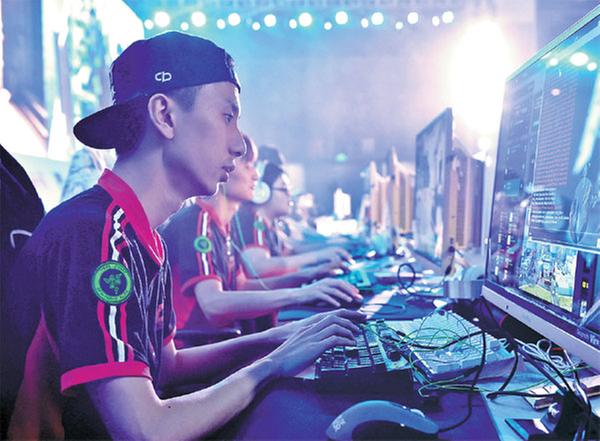
| Four teams compete at the International Esports Tournament in Yiwu, Zhejiang province, on April 27. Lyu Bin / For China Daily |
There are 170 million players and fans in China, surpassing any other regular sports, reports Ouyang Shijia
When Liu Zhenyan commentates live from the Jeunesse Arena in Rio de Janeiro, tens of millions of Chinese viewers tune in to watch the 2017 Mid-Season Invitational, one of the most important annual League of Legends gaming tournaments in the world.
Liu, known by her nickname "Su Xiaoyan", is one of many popular esports commentators in China catering to a rapidly growing audience of young fans.
China has become a key esports market. Last year, the country generated 50.46 billion yuan ($7.3 billion) in revenues, up by 35 percent from 2015, according to gaming research institution Gamma Data Corp.
With hundreds of millions of players and viewers in China, the esports industry is booming, fueled by prize money from local tournaments, and supported by investors seeing it as the future trend.
Now, young fans are aspiring to become esports professionals.
Just a few years ago, teachers and parents would regard teenage video game players as bad students who will bring harmful effects to others, blaming video games for their addictive nature, similar to drugs or gambling.
That's exactly what Chen Zhihao's parents thought. But the other day, they spent hours watching their son play. The 27-year-old Chen has won several local and international games.
In July 2014, Chen was part of the five-member Newbee team, which won the world's richest esports tournament - the $5 million International DOTA2 Championships in Seattle, Washington.
DOTA2, short for Defense of the Ancients 2, is a multiplayer game in which two five-member teams battle to break the other's stronghold. Known as "Hao", Chen now works for the esports club Vici Gaming in Shanghai. He fell in love with video gaming when he was little, around 6 or 7.After he graduated from high school, he stayed home for a couple of years, focusing on becoming one of China's leading player.
"During that time, I would spend more than 10 hours a day playing video games. Without the boom of esports and the chance to be a professional player, I would probably stay in Guangdong province to find a normal job, earning thousands of yuan per month," said Chen, who is preparing for the next round of DOTA2.
Chen told China Daily in a recent interview that the industry is growing fast.
"Before 2014, my annual income could reach 1 million yuan at most. After that, I was able to earn millions of yuan annually.
"Most of the money comes from the live-streaming platforms I signed with, the gaming prize money and the salary paid by the esports club I joined," he said.


