How a desert branched out to become Beijing's guardian









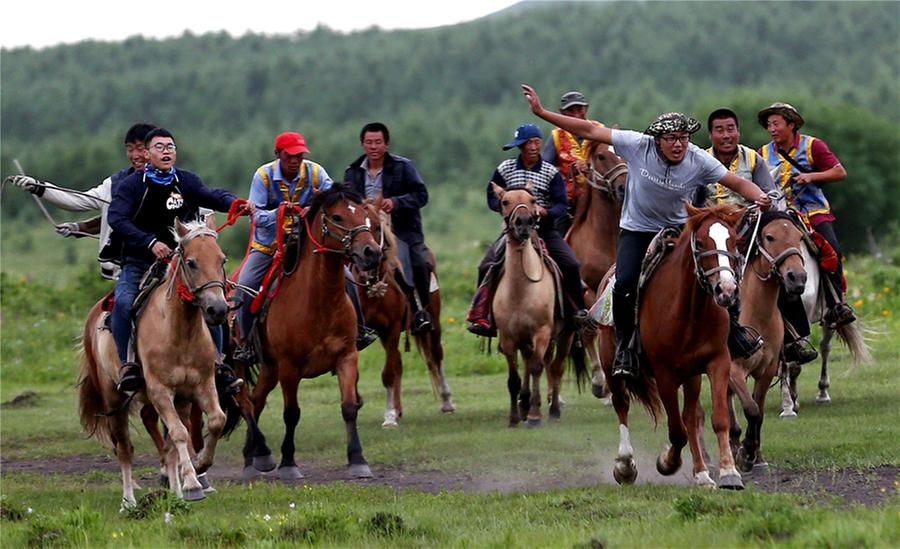 |
| Tourists ride horses with local guides on a trail in Saihanba National Forest Park, which is known for its eco-tourism.[Photo by Zou Hong/China Daily] |
Hunting ground
In the 10th century, the area became a hunting ground for the rulers of Liao, an empire founded by nomadic people in North China.
Empires rose and fell, but Saihanba continued to charm. The land, composed mainly of boundless forests and grassland dotted with crystal-clear plateau lakes, remained popular with China's rulers, especially during the 17th century. Emperor Kangxi (1654-1722), the longest-reigning ruler of the Qing (1644-1911), China's last dynasty, was so smitten by the area's beauty that he hunted there. Historical records suggest that he set a personal record of 318 rabbits in a single day's hunting.
The dynasty started to wane in the early 19th century. In about 1860, the reigning emperor, with neither the funds nor the temperament to maintain extravagant hunting tours, opened the land to the public.
Farmers and herders moved in, and in the decades that followed trees were felled, the forests and grassland disappeared and the beauty of Saihanba vanished. It was the beginning of nature's revenge.
By the 1950s, Saihanba had long ceased to be a beautiful highland area 280 kilometers north of Beijing. Instead, it was a passageway through which the wind blew the sand of the deserts of Inner Mongolia all the way to the capital. According to the bleakest predictions, Beijing would be buried under sand within decades.
Yin's job was to halt the process. She was not alone: 127 graduates-mostly forestry majors-arrived from two technical schools and a college to join the 242 people who were already there.
By 1962, the surrounding area was designated a national forest.
Then, the average age of the area's 369 inhabitants was 24. Today, more than half of them have died, partly as a result of the harsh natural environment and partly because of the hard labor required to grow the forest. Their average life span was 55 years.