



Truths about Indian troops' illegal entry into Chinese territory









BEIJING - On June 18, Indian border troops crossed the China-India boundary in the Sikkim sector at the Duo Ka La (Doka La) pass and advanced more than 100 meters into Chinese territory.
The illegal crossing of a delimited boundary and entering the territory of a neighboring country violate China's sovereignty and territorial integrity, international law and basic norms governing international relations.
India has invented various excuses to justify its illegal action. The following are the facts:
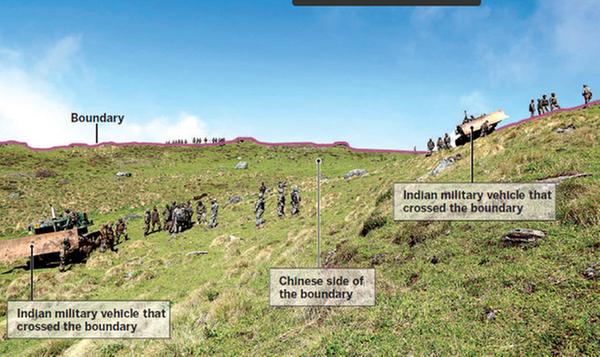 |
| A Foreign Ministry photo released on Wednesday shows Indian troops encroaching on Chinese territory. Provided to China Daily |
What happened on June 18?
On June 16, the Chinese side was building a road in the Dong Lang area (Doklam), located in Yadong county of the Tibet autonomous region of China. On June 18, over 270 Indian border troops, carrying weapons and driving two bulldozers, crossed the boundary in the Sikkim sector and advanced more than 100 meters into Chinese territory to obstruct the road building of the Chinese side, causing tension in the area.
The trespassing Indian troops, reaching as many as 400 people at one point, put up three tents and advanced over 180 meters into Chinese territory. As of the end of July, there were still over 40 Indian border troops and one bulldozer illegally staying in Chinese territory.

Does the Dong Lang area belong to China?
Yes.
The main focus of the dispute is the Dong Lang area.
In 1890, China and Britain signed the Convention Between Great Britain and China Relating to Sikkim and Tibet. Article I of the Convention stipulates that "The boundary of Sikkim and Tibet shall be the crest of the mountain range separating the waters flowing into the Sikkim Teesta and its affluents from the waters flowing into the Tibetan Mochu and northwards into other Rivers of Tibet. The line commences at Mount Gipmochi (currently known as Mount Ji Mu Ma Zhen) on the Bhutan frontier, and follows the above-mentioned water-parting to the point where it meets Nipal territory."
According to the Convention, the Dong Lang area, which is located on the Chinese side of the China-India boundary, is indisputably Chinese territory.
The stability and inviolability of boundaries are a fundamental principle enshrined in international law. The China-India boundary in the Sikkim Sector as delimited by the 1890 Convention has been continuously valid and repeatedly reaffirmed by both the Chinese and Indian sides. Either side shall strictly abide by the boundary which shall not be violated.

Is Bhutan involved in the incident?
No.
The 1890 Convention has made it clear that the China-India boundary in the Sikkim Sector commences at Mount Ji Mu Ma Zhen on the Bhutan frontier. Mount Ji Mu Ma Zhen is the eastern starting point of the China-India boundary in the Sikkim Sector and it is also the boundary tri-junction between China, India and Bhutan.
The Indian troops' trespassing occurred at a place on the China-India boundary in the Sikkim Sector, more than 2,000 meters away from Mount Ji Mu Ma Zhen. Matters concerning the boundary tri-junction have nothing to do with this incident.
China and Bhutan have been engaged in negotiations and consultations to resolve their boundary issue since the 1980s. Although the boundary is yet to be formally delimited, the two sides have had 24 rounds of talks, conducted joint surveys in their border area and have reached basic consensus on the actual state of the border area and the alignment of their boundary.

What are the consequences of India's illegally crossing the China-India border?
According to the United Nations (UN) General Assembly Resolution 3314 adopted on Dec. 14, 1974, no consideration of whatsoever nature, whether political, economic, military or otherwise, may serve as a justification for the invasion or attack by the armed forces of a State of the territory of another State.
To cross a delimited boundary and enter the territory of a neighboring country on the grounds of so-called "security concerns," for whatever activities, runs counter to the basic principles of international law and basic norms governing international relations.
As a third party, India has no right to interfere in or impede the boundary talks between China and Bhutan, nor does it have the right to make territorial claims on Bhutan's behalf. India's intrusion into Chinese territory under the pretext of Bhutan has not only violated China's territorial sovereignty, but also challenged Bhutan's sovereignty and independence.
The Chinese government urges the Indian government to immediately withdraw its trespassing border troops back to the Indian side of the boundary and conduct a thorough investigation into the illegal trespassing so as to swiftly and appropriately resolve the incident and restore peace and tranquility to the border area between the two countries.
Full text of facts and China's position concerning Indian border troops' crossing of China-India boundary
- India blocks Fosun's $1b Chinese pharmaceutical acquisition: Media
- India's border recognition statements over the years
- Full text of facts and China's position concerning Indian border troops' crossing of China-India boundary
- US scholar: India should remember the history
- US experts call for India border withdrawal








