



A destiny of love through music









A virtuoso heard his father's voice in the sonorous strings of the cello
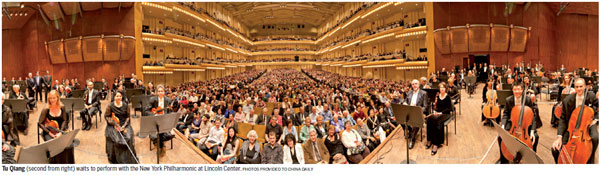
As the first Chinese musician to join the New York Philharmonic, cellist Tu Qiang still feels humble, even after two decades of being part of the oldest symphony orchestra in the United States.
"Solos feature personal performance, while a symphony features not only personal performance but collective cooperation," Tu said in an interview with China Daily.
"The feeling is unparalleled - to express as much passion as you can but within a framework of cooperation," Tu added.
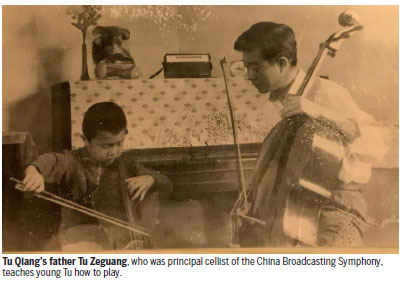
Joining the philharmonic in 1995 as the first ever Chinese musician in the orchestra, Tu began his cello studies as a 7 year old with his father Tu Zeguang, who was principal cellist with the China Broadcasting Symphony.
Tu's first cello was handmade by his father and friends who worked at an instrument factory. Tu still remembers the half-sized cello customized just for him made with wood from a bed board. His father made him three more instruments along the way.
"By modern standards, the craft value of those cellos was not that high, but the affection between my father and me carried by those cellos is something that cannot be matched," said Tu.
A love of classics
Tu's father not only taught Tu how to play cello, but also instilled in him a love for classical music.
Tu became obsessed with the sound of the cello as a child listening to his father practice.
"It felt like my father was talking to me," he said. "I later found out that it has long been claimed by musicians that the cello is the instrument that most closely resembles the human voice.
"Maybe I was destined from that moment to be accompanied by a cello for my lifetime," Tu said.
Making his solo debut at the age of 13 in Beijing in 1977, Tu began a two-year engagement as soloist with one of China's major symphony orchestras.
At age 17, he was awarded England's Menuhin Prize as a member of the China Youth String Quartet and was later selected by the Chinese government to study at the Sydney Conservatory, where he won the Parlings Award for Music.
Returning to Beijing, he was appointed associate professor of cello at the China Central Conservatory at the age of 20. At the same time, he became principal cellist of the China Youth Symphony and performed with it in Switzerland, West Germany, France, Belgium, Italy, and Great Britain. His solo album, Meditation, was released by the China Record Corp.
Larger view
At a time when it seemed his prospects could not have been brighter, Tu quit his job. His study-abroad experiences inspired him to take a larger view. He wanted to become a world-class musician, which was also his father's dream for him.
With just $30 in his pocket, 22-year-old Tu boarded a flight to the United States.

"It was tough," Tu recalled.
He first went to UC-Santa Barbara on a scholarship, and then to Rutgers University to study with renowned cellists Bernard Greenhouse, Zara Nelsova and Paul Tortelier.
In 1995, Tu passed the tryouts and became the first Chinese musician in the more than 150-year history of the New York Philharmonic.
Before joining the Philharmonic, Tu said he had subbed with the orchestra.
"My first concert was Brahms' German Requiem with Kurt Masur. I was excited and nervous - suddenly I was sitting next to famous musicians. I was shocked at the orchestra's great sound," he said.
When he joined the orchestra, Tu had to give four concerts a week and there were more than 40 weeks of performance a year. Basically, he had to learn a new repertoire every week.
"I faced unprecedented pressure at that time," he said. To catch up with the orchestra, Tu practiced on weekends as well.
Today, Tu enjoys a multifaceted career as a performer, teacher and advocate for classical music.
Still a member of the New York Philharmonic, Tu has also performed as a soloist, recitalist and chamber musician in Australia, Belgium, China, France, Germany, Italy, Japan, South Korea, Switzerland and the United Kingdom.
As a recording artist, Tu has released multiple solo albums on the China Record Corp label and chamber music recordings on the Bridge Records, Cala Records, and EMI labels.
A dedicated teacher, he is a member of the orchestral performance faculty at the Manhattan School of Music.
For Tu, the cello is more than just a musical instrument - it's also a lifelong gift from his father with love.
xiaohong@chinadailyusa.com
(China Daily USA 08/11/2017 page1)


Today's Top News
- China protests against the break-in at its embassy in Tokyo
- Decisive moments for energy renewables
- China pushes for using patents as innovation incubators
- China offers enabling climate for global firms
- Diplomatic solution to Iran crisis urged
- Trump cites talks, pauses strikes on Iran energy sites


