



Gas ban propels industry changes









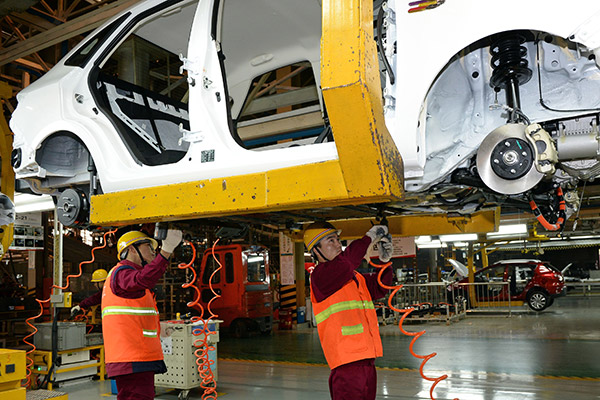 |
| Workers install a battery into an electric car in the factory of JAC Motors, a domestic car company based in Hefei, Anhui province. [Zhang Dagang/for China Daily] |
Automakers will move aggressively to start building hybrids, electric power vehicles
With China announcing a plan to eventually end the production and sale of vehicles powered entirely by fossil fuels, domestic and foreign-owned automakers are expected to be even more aggressive in developing electric and alternative vehicles for the world's largest car market.
Xin Guobin, vice-minister of industry and information technology, said at an international forum on automotive industry development in Tianjin that the ministry is studying when to ban the production of cars that use only traditional fuels.
The vice-minister did not release a specific date when such a ban would occur, according to Xinhua News Agency.
In April, General Motors Co said it would launch 10 types of electric and gasoline-electric hybrid vehicles in China by 2020. Last month, GM introduced the two-seat E100 from GM's Chinese joint-venture brand, Baojun, and costs around $5,300. It has a range of 153.6 kilometers per charge and a top speed of 99.2 kph.
Ford Motor Company said last month that it was exploring a joint venture with electric car maker Anhui Zotye Automobile Co to build a new brand under which the electric vehicles will be sold. Both firms will hold a 50 percent stake in the JV, it said
Other auto producers such as Tesla Inc, Volkswagen AG, Honda and Nissan Motor Co also have announced aggressive plans to make and sell electric vehicles in China.
Among domestic manufacturers, Warren Buffett-backed BYD led in sales in the first seven months of this year, delivering 46,855 electric and plug-in hybrid vehicles, according to the China Passenger Car Association.
"Chinese authorities are looking to fast track new energy vehicle (NEV) sales, but despite subsidies the growth in volume in the NEV segment amounts to just around 1.8 percent of the total vehicle market in China so far this year. The authorities are beginning to look for tougher and more stringent ways to strengthen the NEV segment," wrote Namrita Chow, principal automotive analyst of IHS Markit, in an email.
Noting the lack of a specific timetable for the phasing out of fossil-fuel powered vehicles, Chow said "at this point in time it is just rhetoric regarding the complete ban of (internal combustion engine) vehicles in China, there is no time line and no policy implying this is at all imminent."
Arthur Wheaton, an automotive expert with Cornell University's School of Industrial and Labor Relations, said that because Chinese auto market is the largest in the world, all global auto companies will make an attempt to meet whatever policies are in place to continue in the market.
"The policy of outlawing all internal combustion engines for sale in China would be extremely challenging," he said in an email.
SAIC, BAIC, Geely and Changan are among the Chinese auto companies that could capitalize if the ban is implemented, said Wheaton.
Those companies and others have significant partnerships with global manufacturers and their joint-ventures would be crucial in ramping up capacity to meet the needs, he added.
Still Wheaton doesn't anticipate a ban happening anytime soon.
"I am pessimistic this policy will be implemented fully for decades. I think the phasing in of increasing (the) number of electric vehicles is more likely and the slower pace would help Chinese auto makers build expertise to meet the demand gradually with help from their joint-venture partners," said Wheaton.
France and the United Kingdom announced in July they will stop sales of petrol and diesel automobiles by 2040 as part of efforts to reduce pollution and carbon emissions that contribute to global warming.
















