Emperor Qianlong's southern belle









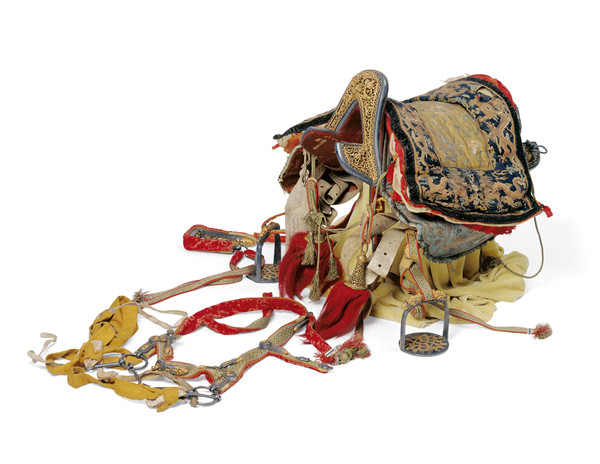 |
| Emperor Qianlong's saddle. [Photo provided to China Daily] |
And when it came to Hangzhou, a city by the Qiantang River, fulfilling royal duty meant to push forward and monitor the building of levees.
"The Qiantang River, running for more than 500 kilometers before pumping its torrential water into the East China Sea, was Hangzhou's biggest natural threat until very late in the country's contemporary history," Ma says. "Bearing in mind that Hangzhou and its surrounding regions were the empire's crucial source of tax income, keeping the destructive waters at bay was the emperor's top priority."
According to Le Qiaoqiao of the Zhejiang Museum, who is also behind the exhibition, the emperor even aroused debate in his court as to the type of levees to be built.
"The choice was between wooden ones and stone ones. The first were cheaper and relatively easy to build, and the second were stronger so could be expected to last longer. Most court officials opted for the wooden ones, arguing that Hangzhou, so far from Beijing, the imperial capital, would pose no serious threat to social stability even in case of a flood. The matter also became tangled up - as such matters invariably did - in court politics.
"However, the emperor stood firmly behind the second option, and the decision was made to build extended stone levees during his fifth visit. That decision proved to be the correct one, no serious flood occurring after the levees were completed, and only small-scale mending was required in ensuing years."
It is also worth noting that one of the emperor's most important appointees was an official named Zhu Shi. Zhu made his way into the emperor's service through sitting a test presided by Qianlong himself during one of his early trips to Hangzhou. The examinees were required to answer a question about the levee.
The levees were made of stone blocks piled up neatly one layer upon another, vividly dubbed the fish-scale levee. Vestiges remain, reminding us of an emperor whose multiple journeys to Jiangnan are often viewed as mere fun trips.