



Bringing the best brains to rural schools









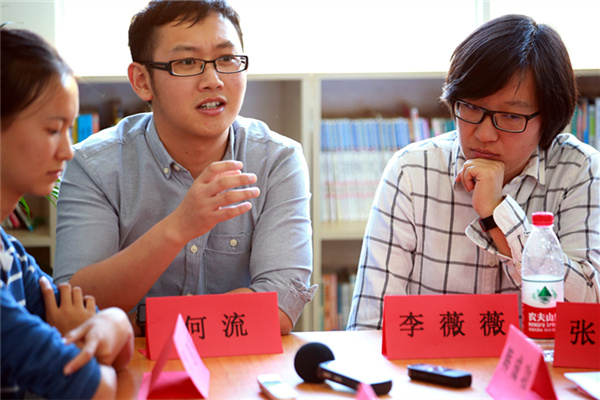 |
He Liu (center) during a teaching seminar with colleagues at Dazhai Middle School. [China Daily] |
Wang Liwei, a researcher at the 21st Century Education Research Institute, a nonprofit organization in Beijing that focuses on education policy research and advocacy, said the quality of rural education is significant because a high proportion of the population still lives in the countryside.
"Poor education in isolated areas compromises the quality of the rural workforce, and that could hamper the country's development. People whose low educational status makes them unemployable also pose a threat to social stability," she said.
In the past decade, the government has spent ever-increasing sums on upgrading the infrastructure of rural schools, providing better buildings and facilities, and introducing preferential policies to attract skilled teachers to isolated areas.
In 2007, the State Council, China's Cabinet, implemented the Free Normal Education Program in six "normal" universities, which are colleges that train teachers for all levels.
Students admitted to the program are exempt from tuition fees and also receive a monthly allowance of 600 yuan ($90) while on campus. Following graduation, they spend a specified period teaching in regions where teachers are in short supply.
In 2010, the National Training Program for Primary and Secondary School Teachers was implemented jointly by the ministries of education and finance.
Under the program, village teachers in Central and West China were given the opportunity to take free refresher courses or attend short-term training sessions at top universities at the State's expense.
In 2012, central government spending on education reached 2.7 trillion yuan, surpassing 4 percent of national GDP for the first time, according to the Ministry of Education. The figure has been rising ever since, and last year it hit 3.8 trillion yuan, accounting for 5.2 percent of GDP.
The increased investment means rural students no longer have to worry about crumbling school buildings, while internet access and multimedia teaching facilities are now commonplace.
"If you take a tour of the countryside now, it's amazing to see that schools are always the fanciest buildings," Andrea Pasinetti, founder and CEO of Teach for China, said.
However, according to Wang, the researcher, despite the improved infrastructure, some rural areas are still experiencing severe shortages of skilled teachers.
"The lack of talented teachers means the better-off parents send their children to schools in nearby townships and big cities, but, in return, the loss of students exacerbates the problem of teacher shortages because they also gravitate toward larger towns. It's a vicious circle."


