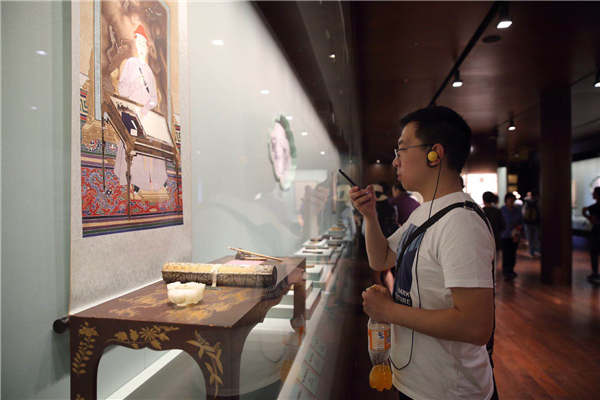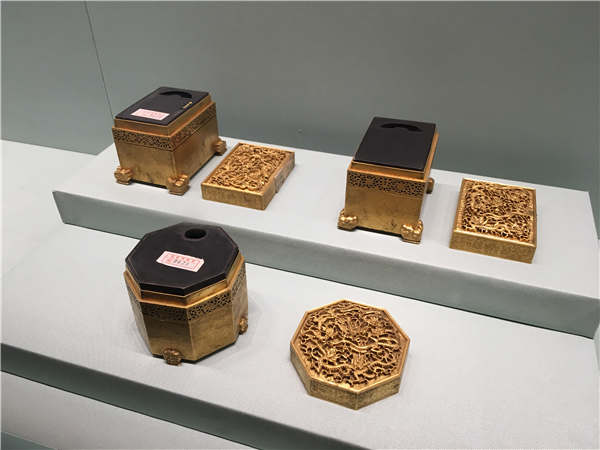
A digital journey through an ancient scroll, 'blank-period' porcelain and inkstones are on display at the Forbidden City as part of International Museum Day events. Wang Kaihao looks at these unconventional exhibits.
May 18, or International Museum Day typically, is full of surprises at the Palace Museum in Beijing, also known as the Forbidden City.
Much focus at the former imperial palace on the recent International Museum Day was devoted to the new digital display of China's most-celebrated ancient painting, Along the River during Qingming Festival, from the 12th century.
Visitors can take a virtual ride along the "river" to experience the prosperity of the capital city of the Northern Song Dynasty (960-1127), thanks to 4D-dome cinema technology.
Two other exhibitions that opened the same day were equally unconventional.
The first displays rarely exhibited porcelains from the "blank period" of the Ming Dynasty (1368-1644) in the museum's Palace of Prolonging Happiness.
The Exhibition of Ming Dynasty Official Porcelain from the Zhengtong (1436-49), Jingtai (1450-57) and Tianshun (1457-64) Periods, which will run through June 17, shows 215 exhibits of a neglected segment of Ming porcelain. These pieces are often ignored today, even though the dynasty is generally considered a peak period in Chinese ceramic history.
In 1369, the "imperial kiln" was completed in Jingdezhen, in today's Jiangxi province, to produce exclusively for the royal family.
Most exhibits come from archaeological discoveries made in Jingdezhen in 1988 and 2014.
There was no porcelain exhibition particularly focusing on these periods anywhere before, says Lyu Chenglong, a researcher with the museum.
"The decades are called the 'blank period' because we haven't found any official porcelain bearing the names of the three emperors' reigns," he explains.
One exception is an exhibited bowl from a privately owned kiln in today's Hubei province, created during the reign of Tuanshun.
It was common practice in ancient China to inscribe the bottom of porcelain pieces with production reigns.