Millions working in shadow of sharing, but uncaring, economy









Insurance dilemma
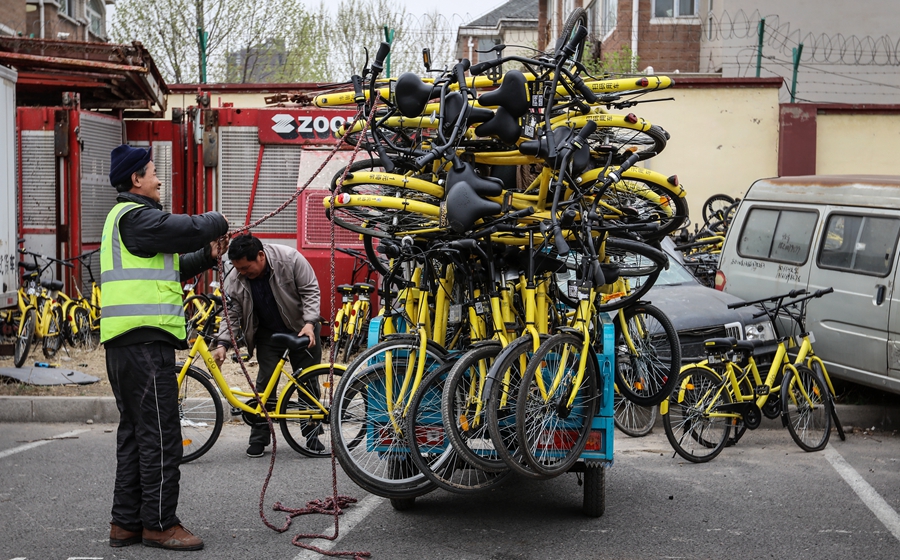
Wang didn't know that his medical costs would have been covered if his employer had provided insurance against occupational injury. However, like many of the 70 million people employed in the sharing economy, he was not covered for occupational injury and had no access to a medical care program.
China's Labor Law and the Labor Contract Law stipulate that companies judged to have "labor relations" with employees are obliged to contribute the lion's share of payments toward five types of social security, including injury, medical and endowment insurance, while workers pay a minimal amount.
However, while the signing of an employment contract is often seen as signifying "labor relations", the law does not provide a standard definition. Meanwhile, few people who work for online platforms sign labor contracts, meaning they are not technically employed by the platforms, which are therefore not required to contribute to their social security payments.
E-Daijia, a leading designated driver platform, said its 200,000 drivers are classified as part-time employees. "They all have their own formal jobs, and are free to offer their services or rest any time they want. We sign service contracts with them directly and have no obligation to shoulder their social security requirements," said Zhang Dongpeng, a publicity officer for the company.
Platforms such as E-Daijia provide drivers for clients who are either unwilling or unable to drive their vehicles for various reasons, such as excessive alcohol consumption or the need to work en route. The designated drivers, who ride small e-bikes, accept orders via the company's mobile app, and when they rendezvous with the client they simply load their bike into the trunk of the car and drive to the specified destination.
Complex model
Other platforms, such as Ele.me, Baidu Waimai and Meituan Waimai-the country's three biggest online food delivery platforms-use a more complex employment model in which they cooperate with third-party companies that recruit casual workers via service contracts. The arrangement means neither the third party nor the online platform is obliged to contribute toward workers' social security payments.
"The model understands the needs of the delivery industry and benefits our operating efficiency," said Cai Min, a publicity official with Ele.me.
Liu Zhong works as a designated driver for Didi Daijia, a larger competitor of E-Daijia, in Beijing.
"I signed a service contract with a HR company in Zhejiang province, even though I work in Beijing. The contract I signed makes no mention of social security payments," said the 28-year-old native of Henan province. Calls requesting an interview with Didi Daijia were not returned.
Jiang Ying, director of the School of Law at China University of Labor Relations, said the model has a high degree of flexibility.
"Online platforms outsource their labor requirements to third-party companies. There's no fixed period of employment, so the platforms can decide whether to continue to use workers according to the prevailing business conditions," she said.
"Additionally, the model saves the online platforms money. Hiring workers directly requires high expenditure-for example, contributing to their social security payments.
"However, without the security provided by employment injury, medical and endowment insurance, the workers may experience financial troubles if they are involved in an accident, fall sick or just grow too old to do the job."





- China-Russia joint aerial strategic patrol shows shared resolve, capability to address regional security challenges: spokesman
- Rednote ban undermines freedom, harms interests of Taiwan people: mainland spokesman
- Shantou fire death toll rises to 12
- Former Chinese official Qizhala being prosecuted for bribery
- China launches Lijian 1 rocket, sending 9 satellites into orbit
- 'Trend' voted word of 2025 across Taiwan Strait