Action needed to preserve the past










Obstacles faced
The slogan "Let cultural heritage come alive" has been widely discussed in recent years since being initiated by President Xi Jinping in 2013.
More than 900 million annual visits are now made to Chinese museums, indicating booming business, but Li Xiaojie said that many sites beyond the jurisdiction of cultural heritage administrations still face obstacles when it comes to revitalization.
"Some people still feel there will be a drop in the social value if more market-oriented efforts are introduced," he said. "The economic value of cultural heritage is not widely accepted."
In the newest edition of the Principles for the Conservation of Heritage Sites in China, published in 2015, "economic value" was finally excluded after fierce debate among scholars.
"However, when ownership of heritage, like ancient architecture, is transferred, it is a de facto trade in properties," Li Xiaojie said. He feels that relevant regulations should follow.
"Putting some immovable cultural heritage on the market does not necessarily change it into cash. The aim is to retain or increase its value," he adds.
Successful attempts on this front have been made in some areas of China.
The renovation of such buildings requires rigid and tailored assessment, and changes to facades and major architectural structures are not allowed.
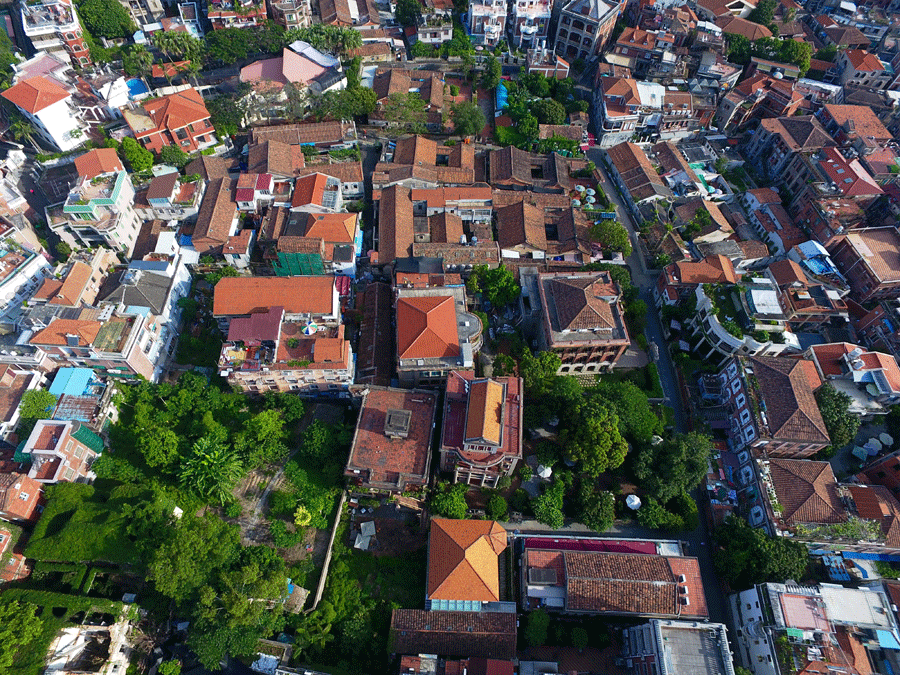
On Gulangyu, a small island off the coast of Xiamen, Fujian province, also known as Kulangsu, different sectors in the local community are reaching consensus on how to maintain the island's vitality. Gulangyu, a UNESCO World Heritage site, is a hub for a range of well-preserved architecture from the late 19th to the early 20th centuries that combines Chinese and Western styles.
Wang Weishan, deputy director of the Gulangyu administration committee, said almost 400 historical buildings out of 1,000 on the island are privately owned.
"Compared with publicly-owned places, the situation regarding these 400 buildings is much more complicated, which makes it more difficult to protect them."
The administration committee encourages local residents to open their houses as holiday homes for tourists, but renovation work is rigidly supervised. Bonuses are provided for those property owners who retain historical features.
An old family temple on the island was used by a clan to worship ancestors. However, it was also a crowded residence for many family members. The committee helped these people to relocate, and returned the building to sole use as a temple. Although it is still privately owned, it is now open to tourists, and displays of traditional rituals are staged there.
An abandoned cinema, which used to house a food market, has been renovated and is now used as a community theater.
Wang said the original functions in about 20 percent of the historical buildings on Gulangyu have been retained, while 12 percent have taken on new business operation roles. "We want heritage to shine again," Wang said. "However, massive commercial development must be avoided."