Highlights from panel on information-based foreign language teaching









More than 1,800 English teachers and leading experts in English teaching from home and abroad gathered in Shanghai on Friday for 2018 TESOL China Assembly, an international conference intended to strengthen dialogue and exchanges between China and the world in English education.
The three-day event, with the theme “English Education in China: Striding into a New Era”, is jointly hosted by the TESOL (Teachers of English to Speakers of Other Languages) International Association, an organization based in the United States that is committed to advancing excellence in English-language teaching, China Daily and Shanghai International Studies University.
Here are some highlights from a panel on on information-based foreign language teaching.
Chen Jianlin, an English professor at Shanghai International Studies University
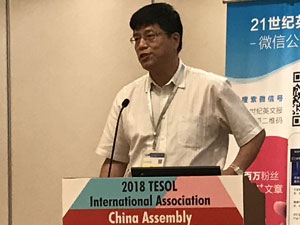
Big data is large, increasing, of great variety and great significance. Big data and information technology can be used to achieve smart English learning - self-directed, motivated, adaptive, resource enriched and technology embedded learning. Information and communication technology can be used to solve problems in English teaching, such as problems in foreign language education planning, dogmatism in following foreign language learning theories and failure to adapt to the characteristics of Chinese English learners.
He Gaoda, dean of the school of foreign language at Guangdong Baiyun University

Any technology which enhanes the rate of learning would enable the teacher to teach less and the learner to learn more.
Information technology changes human being’s cognition and extends our cognition functions. It seems that iPhone has become an organ of human being, and teachers and students increasingly rely on our phones in teaching and learning.
Technology will never replace teachers. However, teachers who know how to use technology effectively to help their student connect and collaborate together online will replace those who do not.
Zheng Yongyan, an English professor at Fudan University, Shanghai
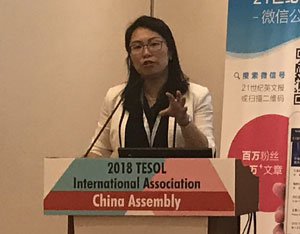
I teach thesis writing to senior college students who are required to write a 10,000-word graduation thesis. The four-month course cannot cover all the important points in thesis writing, and when the course ends in December, students usually start to write thesis in April, so they forget everything I've told them during the actual writing process.
Therefore, I designed an online course and students are required to asses each other’s thesis. I also initiated online forum discussions and I told my students that I would count the number of responses they write. Then the students started to express their views on topics I have given them, which helps them develop their own opinions.
Through online course design and peer-assessment activities, students are allowed to spend more time on practice-based learning of thesis writing and learn about the nature of thesis writing.


- Xizang's remote villages gain access to express delivery services
- Egyptian man explores 460-year-old fair in Tianjin
- 10,000-ton electric container ship tests off Jiangxi province
- China's construction sector sees drop in energy use, emissions during build phase, rise in operations
- Guangdong sees surge in holiday arrivals as travel pattern shifts
- International commercial court established in Guangzhou