



Congestion-free future of urban transport envisioned at conference









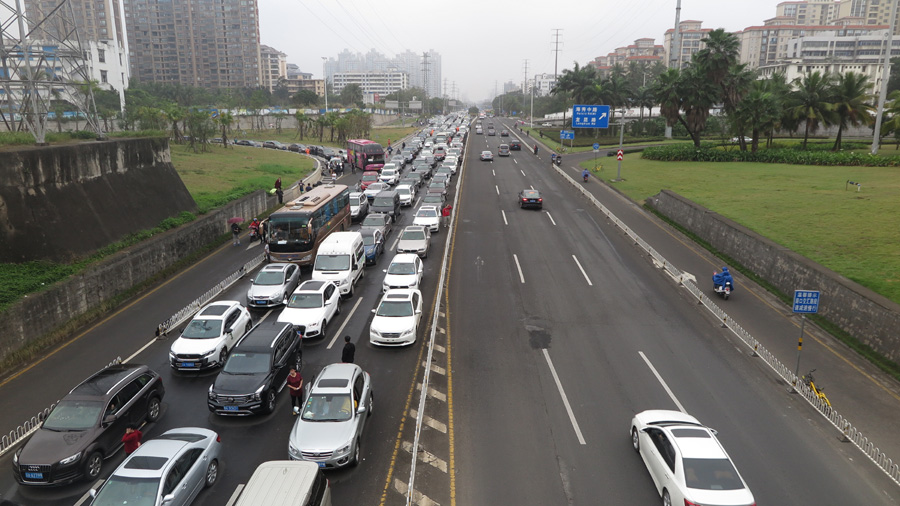
Transport industry insiders and experts from China and abroad envisioned solutions to increasingly serious traffic congestion in big cities at a conference in Beijing last week.
"The city will need a central nervous system to give order to, dispatch and schedule entire transportation systems accordingly, to ensure the best experience, most efficient and safest transport mode," Liu Zhenfei, president of Alibaba mapping unit AutoNavi Software — also known at Gaode Map — said at the 2018 Summit on the Future of Transportation.
Traffic congestion has become a serious issue in China due to the rapid rise in car ownership.
Gaode released a list of the 10 Chinese cities with the worst congestion at the summit on Thursday, with Beijing, Guangzhou in Guangdong province and Jinan in Shandong province occupying the top three spots.
Liu used five scenarios to show how the future city brain could dispatch transportation.
"Commuters traveling more than 100 kilometers can take flying vehicles, and the city brain is playing the role of intelligent air traffic control," he said. "Thanks to the brain's schedule, the frequency of dispatching flying vehicles will be much higher than airplanes nowadays. And importantly, no delays."
People commuting 50 to 100 km will take super-high-speed trains. The city's brain will arrange a precise number of trains to meet demand and schedule departure times. There will be no ticket shortage at peak hours and no empty trains wasting money at off-peak times.
Commuters traveling between 20 and 50 km will take intelligent buses dispatched by the city brain, while those traveling 5 to 20 km will take autonomous vehicles. The brain will calculate the best route and timing to avoid traffic congestion and maximize the number of passengers carried.
Commuters traveling less than 5 km will ride shared bikes, with the brain using data to ensure a sufficient number are deployed to meet riders' needs, Liu said.
Knut Sauer, co-founder of Arrivo, a startup in the United States focused on high-speed urban transport networks, said a solution to traffic congestion is to add a seamless, high-speed super urban network layer to existing infrastructure.
"The speed depends on how much money you invest," he said.
Until June 2016, Sauer was vice-president of business development at Hyperloop One, a main player in the development of next-generation transportation.
He said the new system will increase the throughput of vehicles and improve efficiency to curb traffic congestion. Sauer showed an artist's impression of autonomous vehicles traveling in a tube, with regular cars on parallel freeways.
Sauer envisioned transportation in Beijing in 2040 using the technology. "In 20 minutes, you can be anywhere in Beijing," he said.


- Chinese scientist elected chair of UN commission
- Mideast tensions could increase costs for China's agricultural sector, expert says
- 7.5-magnitude earthquake strikes off Japan, no impact on China coast
- China opens citrus labs with Brazil and Montenegro in Chongqing
- Centuries-old Dong singing festival celebrates ethnic traditions in Hunan
- Chinese scientists discover new diatom species in Shanghai


