The poetry of preservation: Songxi's lyrical culture









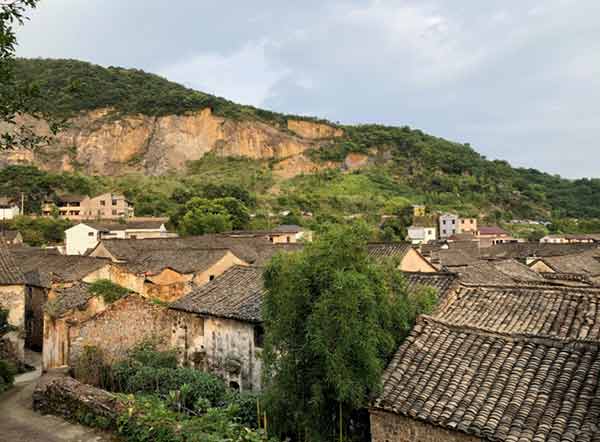
Songxi village, Pujiang county, seen from the opposite side of main entrance. [Photo by Jacob Pagano]
If you walk through the arched gate into Songxi in Pujiang county, a village constructed around several streams in the Tang and Qing dynasties, and ask anyone if they can point you to Zhao Lufu their faces will light up, and they’ll probably direct you to the plant shop where he works. Across from Songxi’s main opera stage, my friend Nora Du and I followed a villager’s directions through the temple to which Lufu’s house is attached, where we found him preparing canvasses. Qing jin, qing jin (“Please come in”) Lu Fu said, as we introduced ourselves as researchers with the Jinhua Homestay Project, a program hosted by the Municipal Government of Jinhua city, Zhejiang province that gives foreigners an opportunity to research the village.
Poetry has been Zhao Lufu’s passion since childhood, and it continues to form an integral part of his daily life. “It is through the right poetic phrase,” he told us, “that we can preserve our lifestyle, and retain the sensations of Songxi—the pace of the village, the flow of curiosity. Let us make some tea and talk more.”
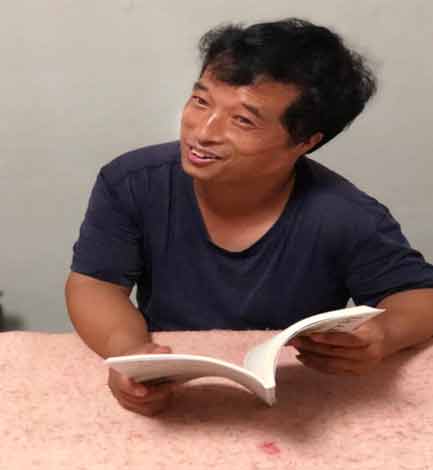
Zhao Lufu reads several original poems from a collection of poetry written in Pujiang county. [ Photo by Jacob Pagano]
Zhao Lufu, a nationally recognized poet and the leader of the Pujiang Fine Arts Committee, was expressing a belief that has long underpinned the core of Songxi culture.
Beginning with founding of the Songxi Poetry Society in the Qing dynasty under Emperor Kangxi, the village has been known for its unique, salon-style poetry culture, with scholars and villagers gathering to share and recite poems and preserving a distinctive literary spirit. The original Society was disbanded when a fire swept through the village and destroyed most of the houses (and, Zhao Lufu added, most of the poetry scrolls) yet several revivals have followed. The “Songxi Yinshe” was founded in the 1940s, and the Songxi Study Society, in 1986, just after the reform and opening-up.
The Study Society today remains as an active part of village life, hosting meetings for students and children, and a major event each summer where scholars gather from around the country to recite poetry and deliver lectures.
Common knowledge often defines cultural preservation through institutional acts or heritage sites, yet Songxi has animated an ancient practice—the creation of a cultural fabric through spoken and written word—as an antidote to the streamlining effects of globalization.
“The Songxi Study Society believes anyone can come together and learn. By having a poetic knowledge, one is more likely to see and detect the relation between oneself and another, or the beauty in a flowing stream, or the mystery in a narrow winding street,” Zhao said.