



Ancient giant turtle with no shell found in China









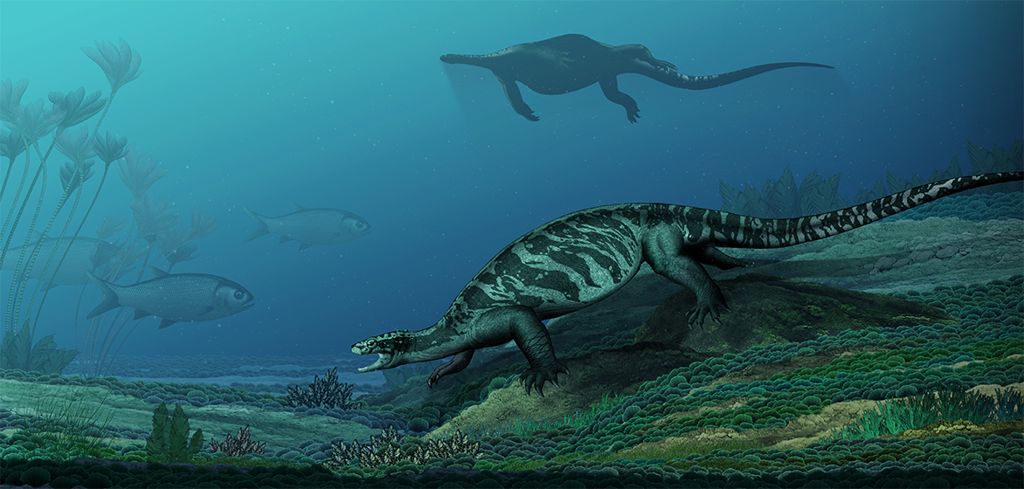
The discovery of a fossilized 230-million-year-old turtle in China has washed away longstanding mysteries about the origins of the marine reptile, according to British and Chinese paleontologists.
Unearthed during an excavation in Guizhou province, southwest China, the two-and-a-half-meter-long sea creature bore little resemblance to the turtles of today - it had long limbs, clawed feet, a whip-like tail and no protective shell of any kind.
The study of the fossil, published in the journal Nature, was led by Li Chun, a paleontologist at the Chinese Academy of Sciences, and co-authored by Nick Fraser, head of natural sciences at the National Museums of Scotland.
Li said the find has added clarity to the evolution of the modern turtle, a subject that has long confounded scientists.
"We are familiar with modern turtles, but the evolution of the turtle remains one of the biggest mysteries in paleontology," Li told Xinhua.
The fossil was discovered in deposits dating back to the late Triassic period, when the very first dinosaurs roamed the earth.
Fraser said that the turtle may have lived in coastal regions and could have spent time on land foraging for food.
"It had these huge claws that it may have used to scrape around in coastal mud and up on beaches, taking out things like mollusks and arthropods, little shrimp and the like," he told China Daily.
Fraser said several of the ancient turtle's features have provided clues into the evolution of modern turtle anatomy. These include the absence of a shell and the presence of a sharp bony beak, similar to those of modern turtles.
The turtle has been named Eorhynchochelys sinensis, which means "first turtle with a beak from China".
Fraser said that some other turtle fossils from around the same period had no beak but did have the beginnings of a shell on the underside of the skeleton, leading paleontologists to theorize that the shell predated the beak in turtle evolution.
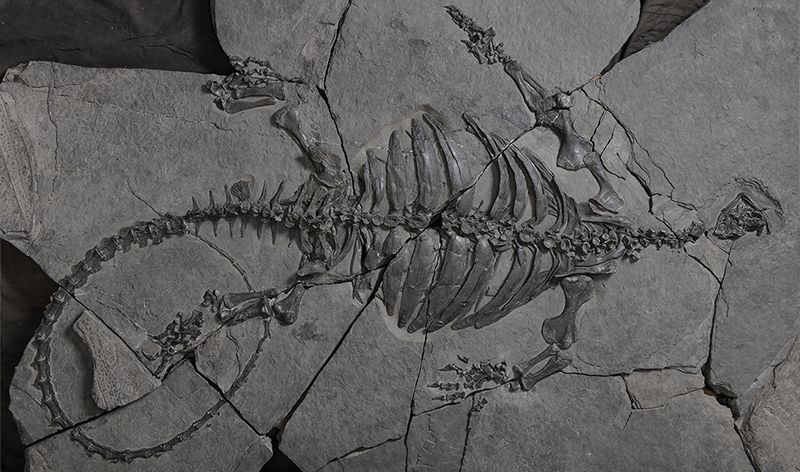
The discovery of Eorhynchochelys has turned that theory on its head, and suggests that the evolution of these distinctive turtle traits did not follow the same trajectory in all turtle varieties.
And a series of holes in the ancient turtle's skull may help clear up how closely related modern turtles are to other reptiles, a topic of much debate in the field of vertebrate paleontology.
Most reptiles, including crocodiles, lizards and snakes, have several distinctive holes where muscles attach to the skull, called fenestra. In modern turtles, these holes are absent, leading some paleontologists to theorize that modern turtles belong to a more distant and primitive branch of reptile ancestors.
Other paleontologists have suggested that those holes were once present in turtles but closed up over time. This theory is now given strong support by the discovery of Eorhynchochelys, which had fenestra in its skull.








