Trial results for world-first LTE-V2X project to be unveiled









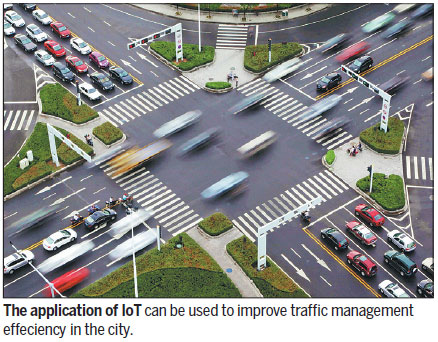
Prototype of intelligent vehicle network management system tested in field experiments, Li You reports.
The results from the trial of the world's first intelligent vehicle network management system are set to be unveiled to the public at the 2018 World Internet of Things Exposition, China's top IoT event held in Wuxi, Jiangsu province, from Saturday to Tuesday.
The LTE-V2X, a project jointly developed by the Wuxi city government, the city's public security administration, China Mobile and Huawei Technologies, was announced in May 3, 2017, with the aim of implementing IoT technologies in the city's traffic system.
The project was put into trial operation in September last year during the 2017 World IoT Expo. Since then the prototype of the network system has been tested out in field experiments.
The wireless communication technology of V2X, also called the vehicle to everything, has been found promising as an aid to people's driving due to its convenience in providing real-time data exchanges between vehicles and the traffic system.
It is a huge interactive network composed of information regarding vehicle location, speed and route. Through satellite navigation and RFID - or radio frequency identification - systems, as well as sensors and camera image processing devices, vehicles can collect the necessary information via the system.
The technology also allows drivers to communicate through LTE, a 4G mobile communications system, thereby enabling all vehicles to transmit the data they collected to a central processing unit.
Through a computer system, the data collected based on the large number of vehicles can be analyzed and processed.
And then, information in need can be calculated and reported to the drivers to guide them to choose the best route in case of traffic congestion or other hazardous situations.
At the launch ceremony in May, its developers announced the project's next-step plan - which is supposed to be completed by the end of 2018 - is to let the system cover 211 intersections scattered around Wuxi's urban area, Taihu Lake New Town, high-speed railway stations, the airport and five viaducts, serving 100,000 vehicles in the city.
And in 2019, the LTE-V2X is expected to be applied in all the areas in Wuxi. In 2020, the city is expected to become the first base for the V2X industry and the industry will be promoted throughout Jiangsu province.
To date, the auto manufacturers involved in the project include Audi China, FAW Group, Ford Motor Co, Chang'an Automobile Co, Volvo, Volkswagen and Peugeot Citroen. Chinese online mapping service provider Amap also participated in the project.
In 2017, the first internationally recognized standard for LTE-V2X was approved by the Third Generation Partnership Project, a working group to define the telecommunications standard. The standard was proposed by Huawei and Datang Telecom Technology and Industry Group.
Xiong Wei, director of Huawei's wireless internet LTE product department, said that the internet of things is significant not only for Huawei, but also for the next generation of the global economy. And the research and development of the technology is not just the company's strategy, but also the strategy for many traditional and emerging industries.
The V2X has become the fastest-growing industry in Wuxi and Jiangsu. It plays a key part in the future of intelligent transportation, whose mission is to improve traffic safety and efficiency, Xiong said.
Huawei has been working on solving the problems facing intelligent transportation in the past few years and has established the 4G-derived cellular car networking technology (C-V2X) LTE-V network in Wuxi.
This year, the project will be open in the major urban areas of Wuxi, which is expected to integrate more industries and vehicles to improve public and private transport.
"Only an open ecosystem can benefit the people better," Xiong said, adding that Huawei will continue to work together with industry partners and governments to drive forward these solutions to address many pressing challenges.