



Xi urges enhancing scientific literacy









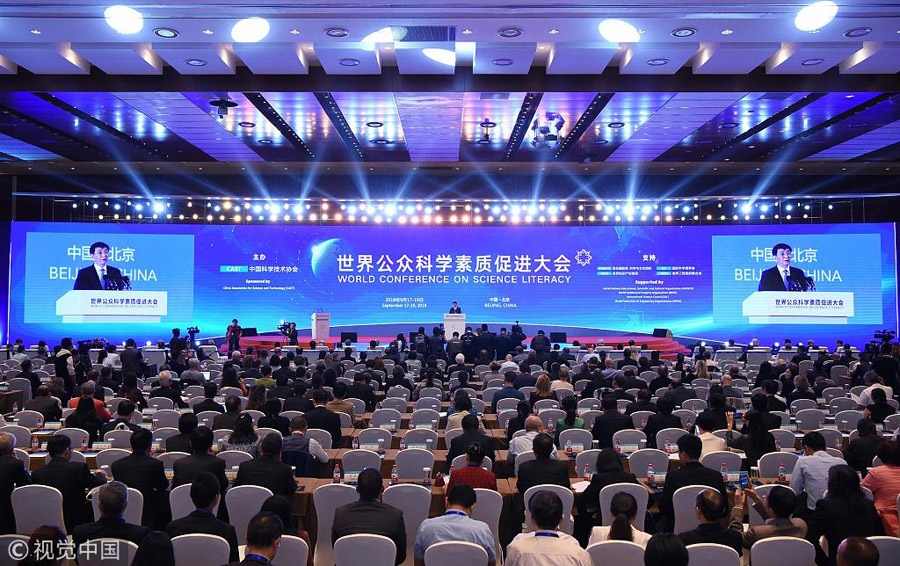
President Xi Jinping said on Monday that China will work with other countries to promote scientific education and literacy domestically and abroad, leading to more innovations that can benefit national and social sustainable development.
Xi, also general secretary of the Communist Party of China Central Committee, made the comment in a congratulatory letter to the opening ceremony of the World Conference on Science Literacy in Beijing on Monday.
The three-day conference is organized by the China Association for Science and Technology, which is marking its 60th anniversary this year.
Organizers called it the first global conference dedicated to promoting science literacy among the public.
Science innovation and science popularization are equally important, and China has attached great importance to both, Xi said in the letter, which was read by Wang Huning, a member of the Standing Committee of the Political Bureau of the CPC Central Committee.
China will actively work with other countries to spread scientific knowledge, uphold the scientific spirit, foster scientific thought, promote science-based methods and contribute to building a community with a shared future for mankind, Xi said. Scientific literacy often refers to the ability to understand, appreciate and use science at work or in everyday life. In 2002, China became the first country to issue laws dedicated to promoting scientific literacy, officials said.
By 2020, China aims to have 10 percent of its population become scientifically literate, according to the State Council.
The figure is at 8.5 percent in 2018, according to the 10th national survey on scientific literacy.
New scientific breakthroughs are reshaping the world, helping societies tackle common issues such as food security, health and climate change, Wang said.
However, new technologies can also create new security, legal and ethical issues, he said.
Increasing scientific literacy can help the public understand and support new technologies and effectively deal with new issues posed by innovations, Wang added.
Antonio Guterres, United Nations secretary-general, said in his congratulatory letter to the conference that many countries have not benefited from science due to poverty, lack of quality education and a digital divide-inequality caused by a lack of access to information technologies.
Wan Gang, chairman of CAST, said improving scientific literacy is key for tackling common challenges and fulfilling the UN's 2030 Agenda for Sustainable Development.


- China forecasts higher grain output, lower soybean imports in 2026
- Chinese researchers propose near-zero-emission coal power technology
- Live stream for good, prosperity for Xinjiang
- China’s supreme court drafts guidelines to tackle AI disputes
- National Conference on Reading opens in Nanchang
- China to curb 'one-size-fits-all' law enforcement on factory ventilation


