


Italian sculptor eyes China's changes









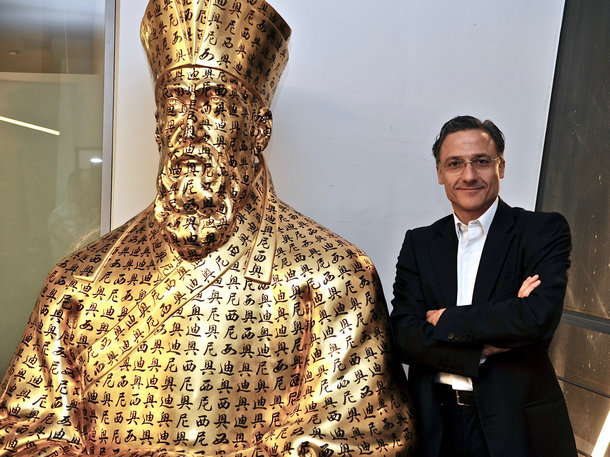
When Italian sculptor Dionisio Cimarelli arrived in Beijing via the trans-Siberian train at the age of 21, he might have been one of the first foreign artists to visit China after it was opened to the outside world in the mid-1970s.
"That was a very incredible trip, and I spent four months traveling and gathering information for my college thesis in China," said Cimarelli in his studio at the Art Students League of New York, where he teaches sculpture.
"At that time, it was very unusual to visit China-not many people went there."
Following the path of Matteo Ricci, the Italian adventurer who is believed to be the first Jesuit missionary to set foot in Beijing's Forbidden City in 1601, Cimarelli didn't finish his journey in China after his short visit in 1986. He went back in 2004 and that time stayed for 10 years.
"When I went back to China in 2004, I was very fascinated by the changes in China," Cimarelli said, adding that in those days China was a relatively poor country that was coming out of difficult economic and cultural times.
He recalled that in the mid-1980s, China had not yet fully opened to international travelers and it was difficult for foreign scholars like him to obtain a visitor's visa longer than two weeks. China was still a developing country with many people living under the poverty level.
Before China's reform and opening-up in 1978, people needed an invitation or work permit approved by the government to travel to China, Cimarelli explained.
Asked about the biggest changes he observed over the past three decades, Cimarelli laughed. "The changes are incredible, too many, I don't know where to start," he said.
In large cities like Shanghai and Beijing, the skyscrapers are everywhere, the improvements to China's infrastructure are unbelievable, and there are many more cars and traffic now.
"The change is everything, especially the people. When I went to China the first time, people they were dressing in green and blue, and now Chinese people are dressing like anyone else in the world, very fashionable."
In terms of art, China has also changed a lot, he said. Back in the 1980s, China's artists were largely influenced by the Soviet art. However, when he went back in 2004 he was excited to see that Chinese artists were starting to interact and exchange with artists from different countries around the world and galleries were full of Western art.