



Poison pill terms will kill fair trade









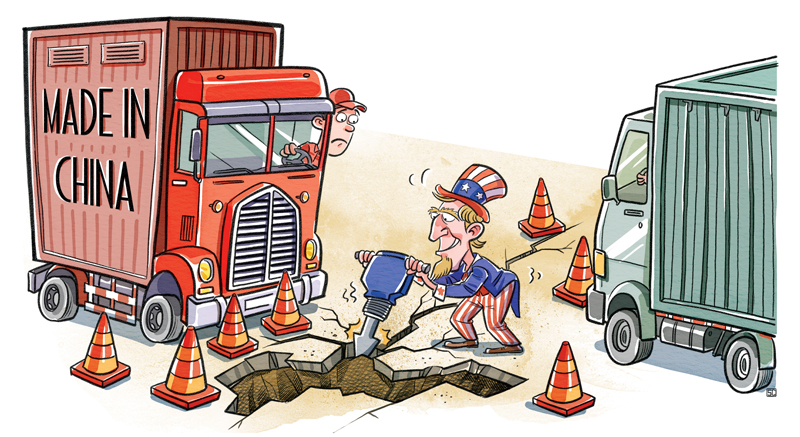
In order to win in its trade competition with China, the Trump administration is preparing to establish international trade and investment rules that favor the United States by building discriminatory trade blocs with its allies.
It wants to replace the WTO rules with trade rules of its own devising, and take advantage of trade terms that are in its favor to seize the high ground in its economic competition with China.
To this end, the US included "poison pill" terms in the United States-Mexico-Canada Free Trade Agreement (USMCA), which was inked in September, to isolate so-labeled non-market economies. And on Oct 16, the United States Trade Representative Robert Lighthizer informed the US Congress that he intends to accelerate the trade negotiations planned with the European Union, Japan and the United Kingdom.
The Trump administration's inclusion of poison pill terms in trade agreements has exposed the US' power politics and unilateralism in the international trade field and has drawn widespread concern.
The poison pill terms that the US is inserting into its trade agreements gives it the power to impose trade sanctions and other punitive measures against any of its partners acting against its wishes. The US as the world's largest economy, is using its market as leverage to force relevant parties to accept its foreign trade rules, in order to maintain the US' economic interests.
The US has continually created global trade fictions in the past two decades by seeking to rewrite the trade rules unfairly in its favor. The trade war launched by the Trump administration against China aims to forcedly open the gates to China's market while at the same time restricting access to its own.
The Trump administration wants to rewrite the international trade rules to seek the maximum interests of the US, while minimizing those of China. Through its poison pill terms, the US wants to shape the international trade order and compel its trade competitor China to submit.
The Trump administration is worried that China's rise as a great power will undermine its advantages. The US is attempting to use the poison pill terms in its trade agreements in order to prevail in what it regards as competition with a rival, and so control the rule-making power of foreign trade rules in the long term to sustain its preeminence.
Poison pill terms are the strategic choice of the Trump administration. US President Trump supports economic nationalism and trade protectionism. He is content to blame the problems of US workers on international trade, and particularly trade with China. He advocates anti-globalization because he is not satisfied with the gains globalization has brought to the US economy and employment.
By using poison pill terms in its trade agreements the US aims to consolidate its strategic alliance relationship with its existing trade allies, as well as isolate and attack its trade competitors. The final goal of the Trump administration is to guarantee the continued dominance of the US in the global economy.
Once the Trump administration successfully inserts poison pill terms in its agreements with its major trade partners, it will enable the US to adopt more effective retaliatory measures against its competitors using trade rules.
The poison pill terms in the trade agreements advanced by the Trump administration will not only undermine China, an important trade partner of the US, they will also destroy the existing global multilateral free trade system based on WTO rules.
The author is a researcher with Chinese Academy of International Trade and Economic Cooperation.


