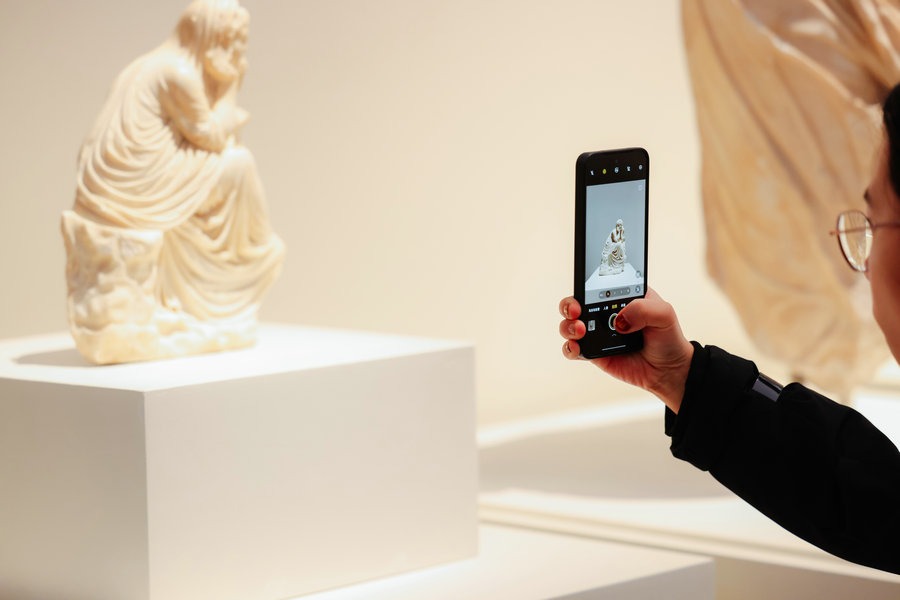
Zhang Nanzhang routinely films short videos of porcelain statues when he visits ceramics studios in Dehua county in Fujian province's Quanzhou city.
He started posting them on Chinese short-video platforms, including Kuaishou, several months ago.
"It's easy and convenient to use my smartphone to shoot the porcelain artworks and share them with others online," says Zhang, who's director of the Quanzhou Arts and Crafts Vocational College's ceramic art department.
"Many are overwhelmed by the statues' beauty. But they don't know many details about them. So, I sometimes share my analyses about how to appreciate them."
Dehua is celebrated for its white porcelain, especially statues, such as those of Buddha. It claims to be China's largest porcelain-handiwork manufacturer and exporter, with an export ratio of 65 percent.
Its porcelain products like tableware were major exports along the ancient Maritime Silk Road in the Song (960-1279) and Yuan (1271-1368) dynasties.
Italian explorer Marco Polo (1254-1324) mentioned the beauty of Dehua porcelain in The Travels of Marco Polo. It's believed that he brought back from China a porcelain jar made in Dehua that's today housed in St. Mark's Basilica in Venice.
Dehua porcelain was shipped to Europe in large quantities and became popular among foreign nobility in the Ming Dynasty (1368-1644). The French called it blanc de Chine (white from China).
The World Crafts Council affiliated with UNESCO named Dehua as a World Craft City for Porcelain in 2015.
When the ninth BRICS Summit was held in Fujian province's Xiamen last year, Dehua white porcelain was selected as state gifts for attendees and the tableware for the state banquets.
Zhang developed the idea to use media to promote Dehua's porcelain culture and art over a decade ago.
He published academic articles in local magazines. But they were only circulated in the county.
"China's short-video-platform boom offers a great opportunity to better popularize Dehua porcelain and reach a wider audience," he says.
Netizens are particularly interested in the sculpting process, he says.
Zhang has over 7,200 fans on Kuaishou.
He plans to invite local artisans to do livestreams with him after he gets more followers.
The county government recently announced its strategic cooperation with Kuaishou. They've opened three official Kuaishou accounts to promote Dehua's white porcelain and tourism.
The county hosts over 3,000 porcelain companies. Over 100,000 of its more than 290,000 people work in the sector, which has a gross value of 22.74 billion yuan ($3.29 billion).
About 3.96 million travelers visited Dehua in 2017, generating 3.84 billion yuan in tourism revenue.
Yu Xuesong, who's in charge of government relations at Kuaishou Technology, says the company is providing local craftspeople and ceramics-studio owners with free training in such areas as marketing to help them realize short-video platforms' potential.
"Consumers are more aware of the goods' added value when they see how they're made," he says.
Zhang also has undergone the trainings. He's confident he'll attract more fans.
The county's deputy Party secretary, Chen Jinzhong, says: "Dehua boasts picturesque natural scenery and porcelain culture. It's important to integrate porcelain culture with tourism to promote it as a destination."
Tourists can visit the county's Ceramics Museum to see various ancient white-porcelain statues and household china, and learn about the production process.
Shunmei Ceramics Culture Center showcases all kinds of ceramics, including china cups with beautiful patterns, tea sets, chopsticks and ornaments. Travelers can also join workshops to make their own porcelain.
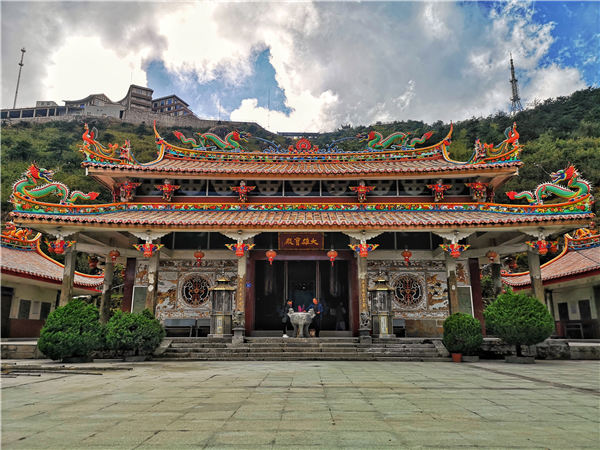
Visitors can also climb Jiuxian Mountain, which literally means nine immortals, to enjoy scenery and explore old temples. A 2.7-meter-tall laughing Buddha carved out of a large rock about 1,300 years ago stands in a cave.
Visitors often spend nights strolling around a street lined with ceramics stores.
"Transportation is improving," Chen says. "A new highway and railway will link us to other cities."
The county is also rebuilding the Shiniu Mountain scenic area and developing more tourism products.
Shiniu Mountain is famous for its peaks, rocks, waterfalls, hot springs and an ancient Taoist temple.
The scenic area will reopen on Jan 1, 2020. It'll have cable cars, an observation deck with a glass floor and a walkway built on brackets fixed to cliffs.
Then, travelers who explore Dehua's porcelain culture will discover there's much more there that makes the county worth visiting.