


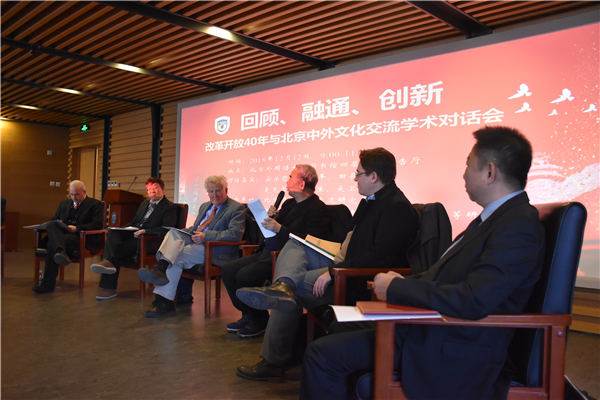
Scholars look at how the country's relations with foreign cultures have evolved over the past four decades.
A group of scholars recently discussed the cultural exchanges that have taken place in Beijing over the past 40 years' reform and opening-up. The scholars of social sciences and the humanities were participating in the academic dialogue Retrospect, Connection and Innovation, held at the Beijing Foreign Studies University.
Beijing replaced Xi'an, once the capital of imperial China in Shaanxi province, to be the cultural center of China during the Yuan dynasty (1271-1368), according to Ouyang Zhesheng, a history professor at Peking University. And since then Beijing has become an international metropolis, Ouyang says.
"Over the past 40 years, we have been driven by a need to introduce the essence of Western culture, hoping to go global," Ouyang says. "But now China and the West have moved to a new stage marked by dialogues and run-ins."
American sinologist Roger T. Ames, an expert on Chinese philosophy, sees changes in Chinese culture now that China has gone through changes in its politics and its economy.
In Ames' view, the core of Chinese philosophy lies in humanity and a growing number of the younger generation in China are seeking their future in traditional cultural connotations.
"Confucianism cannot resolve all the challenges we are facing. However, it should have its place and voice," says Ames, who will be giving lectures on Taoism at the Free University of Berlin for a month from mid-January.
Ames sees value in the mutually beneficial thinking rooted in traditional Chinese culture, which in the words of his former graduate student, Tian Chenshan, currently the director of the center for East-West relations at BFSU, is undervalued in individualistic ideology.
Chinese culture takes human relations, rather than "self", as the priority, says Tian.
"We should keep our own culture in mind in the first place, and then cultivate cultural composure and be critical in order to better learn from other cultures," Tian says.





