



Ultra-strong microscopes open doors to scientific innovation









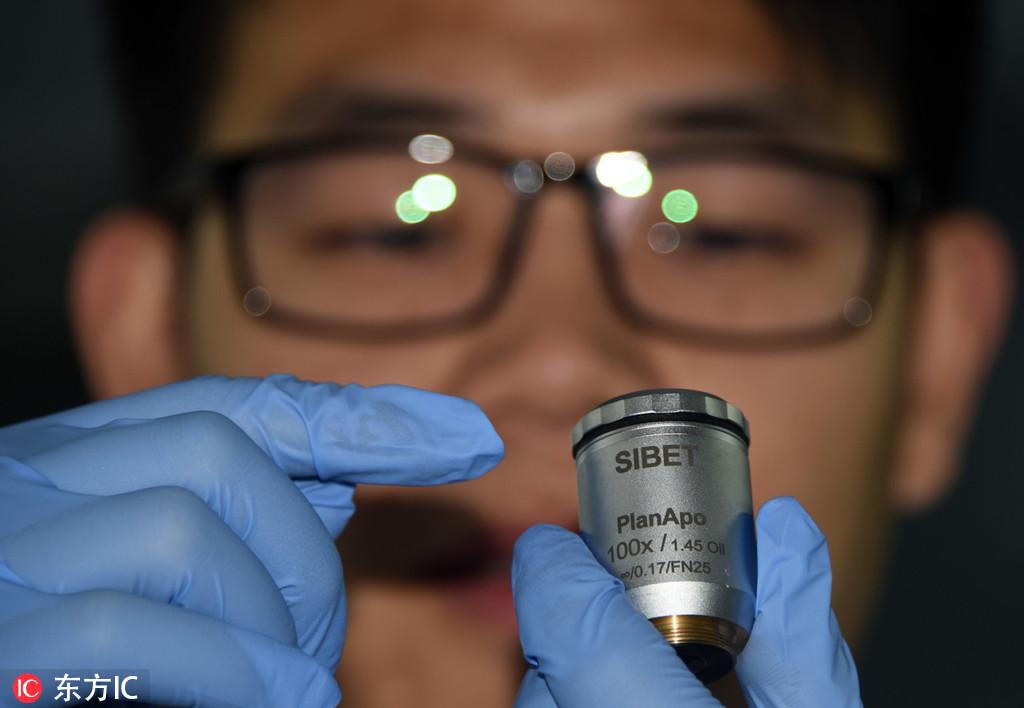
China is now capable of creating super-resolution optical microscopes that can see objects a mere 50 nanometers wide. This allows scientists to observe subtle molecular processes within cells in real time, potentially aiding in the development of new drugs.
Traditional light microscopes are useful for investigating small objects and structures, but they lack precision when the space between objects is smaller than half the wavelength of light used to view them, at which point the two objects can blur into one.
This issue is called the diffraction limit. Since 2000, this challenge has been gradually solved with the advent of super-resolution microscopy, which allows scientists to see and track molecules in action within a living cell. This technique is so valuable for biology and medical research that the Nobel Prize in chemistry was awarded to three microscopy experts in 2014.
As China forges ahead in the fields of microbiology and molecular science, demand for high-end, super-resolution optical microscopes has soared, said Tang Yuguo, director of the Suzhou Institute of Biomedical Engineering and Technology under the Chinese Academy of Sciences.
However, China has had to import most of the core components for these powerful microscopes, and their prohibitive costs restrict the country's innovation in biology, medicine and other cutting-edge fields, he said.
Now, after five years of research, the institute said on Wednesday that it has made breakthroughs in advanced optical microscopes, including the highly sophisticated stimulated emission depletion microscopy. The technique was created by Stefan Hell, a 2014 Nobel Prize winner in chemistry.
The institute introduced special lighting, fluorescent technology and a specialized lens-all of which are key components for producing high-resolution images and visualizing small structures with high clarity.
These feats have helped China become one of the world's leading countries in super-resolution microscopy. But it still lags behind other countries such as the United States, which currently holds the world's highest resolution microscope, capable of viewing objects of just 0.04 nm, the journal Nature said in July.
However, the Chinese super-resolution microscopes are cheaper than their global counterparts, and their resolution is sufficient for many key experiments. The institute said its machines have already been tested and used in many domestic and overseas institutes.
The academy's Shanghai Institute of Materia Medica used these powerful microscopes to track how active ingredients of drugs are being positioned and transported within cells, thus speeding up pharmaceutical development.
Stanford University, the University of Tokyo and other world-class institutes are also using Chinese microscopes to examine the activity of neurons, thus shedding light into the mechanisms by which our brain identifies information and controls behavior.
Wang Ping, a professor of biomedical engineering at Zhejiang University, said people are becoming more confident of China's high-end equipment.
Chai Zhifang, a researcher from the academy's Institute of High Energy Physics, said the microscope project has not only greatly reduced China's reliance on imports, but also has great strategic significance in improving the innovation capabilities of China's biomedical sectors.
Yang Zekun contributed to this story.


