From peanuts to Starbucks, carts on trains move upmarket










"Beer, soft drinks, mineral water! Peanuts, melon seeds, bottled congee!" Millions of Chinese train passengers will hear the call of food vendors pushing trolleys up the aisles during the Spring Festival travel rush.
China expects 413 million train trips to be made during this year's 40-day travel season, as people head home for the most important family reunion of the year, and catering to them during journeys that can last for days is no small business.
Li Hongyang, an attendant on a train running from Fuzhou, Fujian province, to Guang'an, Sichuan province, pushed a cart through 12 crowded carriages for more than three hours, selling more than 30 crates of mineral water and a lot of snacks.
This would have been unimaginable more than a decade ago, when Chinese passengers stinted on train food and deemed bottled water an extravagance, train attendant Yang Xiaofei said.
"Many people would rather jostle across crowded carriages to get free hot water from the electric boiler," Yang said, recalling the train service in 2004. "The best-selling snack was melon seeds, which were cheap and took a long time to finish."
Bottled mineral water is today's best-seller, at least on slower trains, Yang said, and passengers are willing to dig deeper into their wallets for swanky brands.
"Water priced at 5 yuan ($0.70) sells better than the 2-yuan ones," Yang said. "Passengers' purchasing power and willingness to consume have improved greatly. They are increasingly less sensitive to price but more fastidious about quality and brand."
Yang Weijian, a dining carriage director with China Railway Nanchang Group, said the trolley's changing list of goods speaks volumes about China's economic and social changes.
In the early 1980s, flavored peanuts and lard cakes were among the very few snacks sold on trains and were highly sought after, Yang Weijian said. It was a time when China's economy had just started to revive, and candies and pastries were in short supply in small cities.
"There were no carts back then," he said. "The crew just sat in the dining carriage waiting for passengers to come to buy snacks, which were always out of stock at the end of the journey."
Snack carts were introduced in the 1990s when a booming economy led to a groundswell of consumer goods, and the business became lucrative thanks to the large numbers of passengers. One vendor with a cart could sell 10,000 yuan worth of goods during one trip, Yang Weijian said, though most passengers still favored cheap snacks.
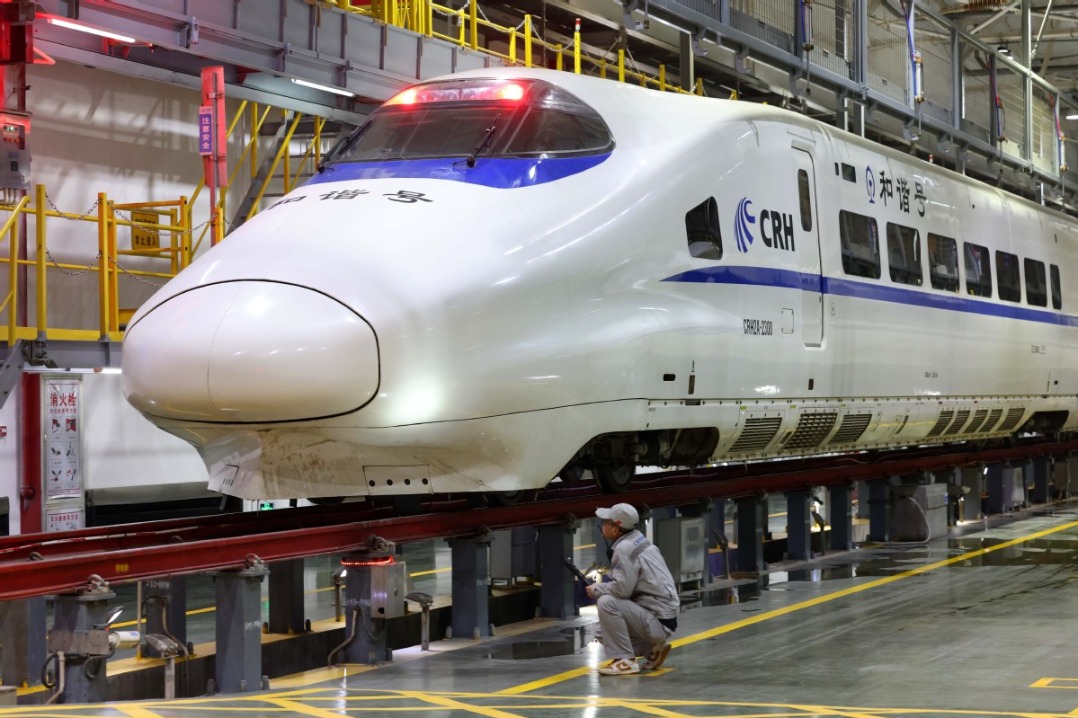
In the following years, snack carts on Chinese trains have grown in size and range of goods to include more high-end items.
"Now Starbucks coffee and Haagen-Dazs ice cream are welcomed by passengers on high-speed trains, though their prices are much higher than traditional snacks, such as melon seeds," Yang Weijian said.
In 2017, China's high-speed railway launched a service to allow passengers to order takeout food from restaurants near train stations if they are not satisfied with the limited choices of boxed meals served on the train.
Delicacies and other goods are also peddled in a more gentle manner, and the bulky, rumbling carts are being replaced by lighter, quieter ones.
"New trains are not as noisy as the old ones, so there is no need for loud hawking," Yang Xiaofei said. "We're now using softer voices to peddle the snacks."




- Agarwood exhibition steeps Shanghai museum in fragrance
- The Fujian Coast Guard conducts regular law enforcement patrol in the waters near Jinmen
- IP protection for new fields to improve
- Draft rules define premade dishes in consumer interest
- Self-powering pacemaker could last a lifetime
- China intensifies crackdown on misuse of personal data