


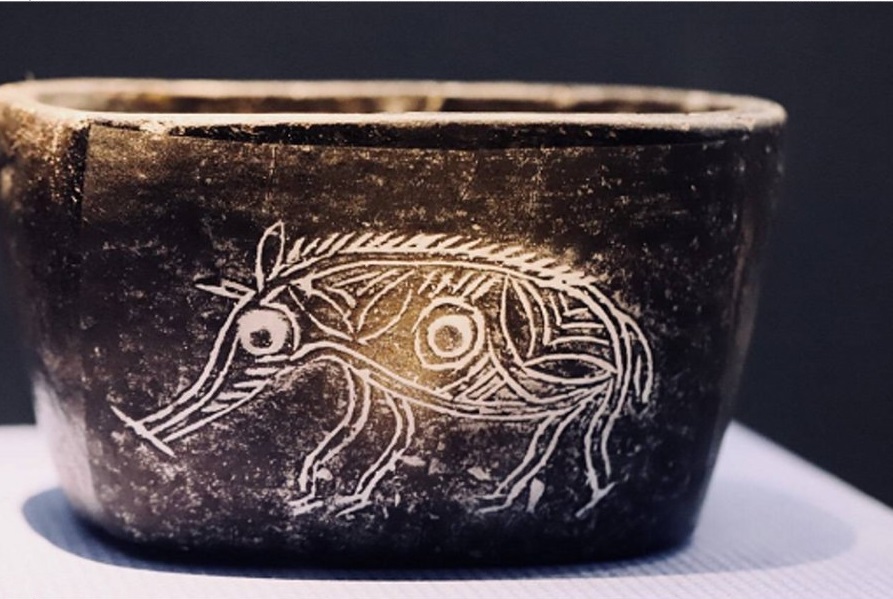
The recent Lunar New Year marks the start of the Year of the Pig, Zhao Xu reports
The pig, which appears as the last of the 12 Chinese zodiac creatures, has undoubtedly struck an emphatic cultural note. The reason, says Shi Chao of the Zhejiang Provincial Museum in Hangzhou, is simple. "We Chinese value family above almost everything else. And, of all the zodiac animals, the pig is the one most closely associated with the Chinese notion of a family," he says, pointing to a piece of oracle bone dating to China's Shang Dynasty (c.16th century-11th century BC)
The symbol on the ox scapula is the antecedent of the contemporary Chinese"家", meaning family.
"The oracle bones are hieroglyphic," Shi says.
"The top of the word resembles a roof, and the part underneath it is believed to be the simplified rendering of a boar or its domesticated descendant, the pig."
In fact, that part eventually evolved into a separate character, "豕", meaning pig.
So, it seems that, to ancient Chinese, no family could be rightfully called a family without pigs.
"Pigs became an important gauge for families' wealth during the Han Dynasty (206 BC-AD 220)," Shi says.
"At the time, to marry into wealth would, in effect, mean marrying into a family with a big pig farm."
Among the funerary objects unearthed from Han tombs are miniature pottery yards complete with henhouses and pigsties.
However, although pigs are said to have been as important to the Chinese as cows were to Europeans and goats were to Arabs, many boar-like images unearthed along the historic transcontinental trade route known today as the Silk Road are believed to have come from the West.
The intricately woven Persian brocade traded on the ancient Silk Road often features medallion patterns centered with the head of a boar.
People of the Sassanian Empire, which was the last kingdom of the Persian Empire before the rise of Islam, were very militarily oriented and therefore worshipped the wild boar, an animal known for its bellicosity.
Another example of cultural exchanges that concerns the image of pigs and boars involves the mural paintings at the Dunhuang Grottoes in Gansu province. With murals dating back to between the fourth and 10th centuries, the grottoes are treasure troves of Buddhist art. In one particular cave, which researchers have numbered 249, a mother pig and her piglet can be discerned amid swirls of color.
With Buddhism, many Indian deities also made their way eastward to China, where they underwent localization.
Among them was Marici, a goddess associated with light and the sun.
Marici was usually depicted as either perched on the back of a boar or riding a fiery chariot pulled by seven savage boars or sows.








