



Economist upbeat on country’s 2019 growth









While most of the world looks to calm anxiety from an economic slowdown, China, the most important global growth engine, is finding ways to maintain its vitality through supportive macro policies and technology-driven innovation.
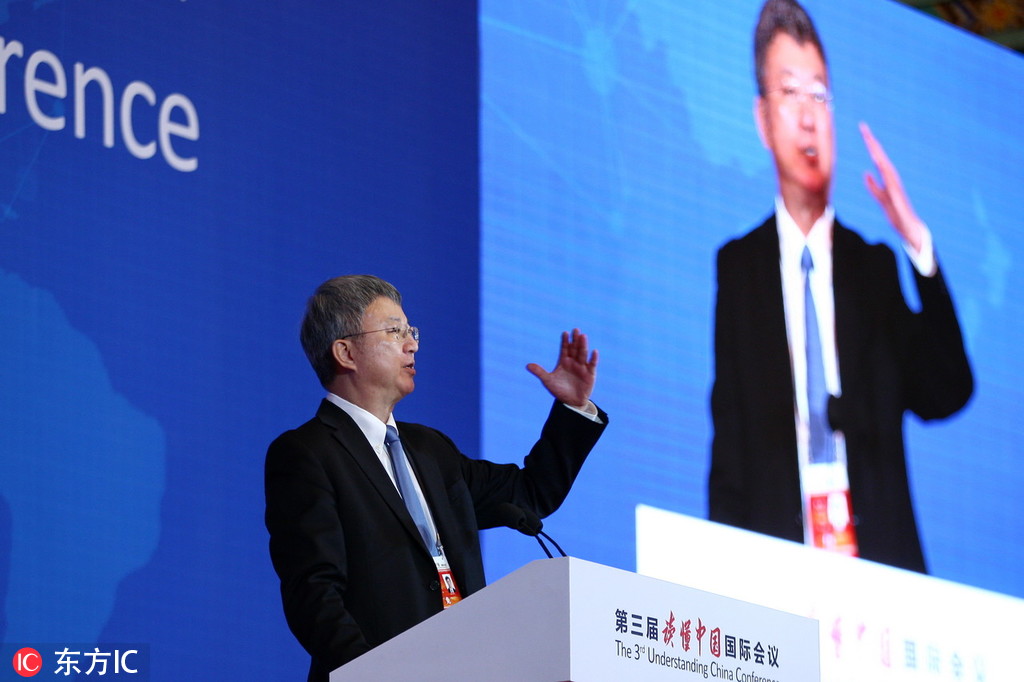
That point of view was shared by Zhu Min, an influential Chinese economist and a former deputy managing director at the International Monetary Fund, who sat down for an exclusive interview with China Daily last week. Zhu spoke just before the annual two sessions in Beijing, attended by international media outlets that have been asking about the basis for China’s forecast of healthy economic performance in 2019.
“We did a study that estimated China would continue to have more than 6.3 or 6.4 percent growth this year,” he said.
Even if the pace of growth moderates from last year’s 6.6 percent, China will be able to maintain the globe’s strongest economic engine and contribute more than 30 percent of the world’s GDP growth, said Zhu, who is now chairman of the National Institute of Financial Research at Tsinghua University.
Zhu, who has a sound academic background and once was a member of Princeton University’s Board of Trustees, has been monitoring China’s macroeconomy over the long term. His confidence comes as authorities have taken measures to stabilize growth. Policies include financial sector deleveraging, increasing investment in infrastructure and encouraging loans for small and private companies.
He said he expects further financial reforms, adding that China’s exchange rate policy will move forward into a market-based system — particularly this year, in tandem with the continual opening-up of financial services.
“The market-based renminbi exchange rate is good for China and good for the whole world,” he said.
Before his appointment in 2011 to deputy managing director at the IMF, Zhu joined the People’s Bank of China in 2009 as a vice-governor. That experience helped him gain a greater understanding of the proper monetary policy to influence the overall economic environment.
“Currently, we see a little bit of easing of monetary policy, but it is still in a neutral position,” he said, meaning neither too tight nor too loose.
He called that “very important” and part of a “new policy mix” that includes cutting banks’ reserve requirement ratios instead of lowering interest rates and guiding liquidity into small and medium-sized enterprises and the private sector instead of cycling it within the financial system.
“So the current monetary policy fits the macroeconomic situation quite well, and it is not a broad quantitative easing,” Zhu said.
“We are very happy to see that China’s debt level has stabilized since last year, although deleveraging is not an easy process,” he said.
“The financial sector’s deleveraging is going very well, but corporate debt is relatively high and household debt is still increasing.”
Zhu’s former IMF colleague Christine Lagarde, the fund’s managing director, said in a Feb 28 speech that after a decade of reform in global financial regulations, “financial systems are safer today, but not safe enough”.
“Countries need to regulate underwriting standards in high-risk debt markets, including leveraged loans,” Lagarde warned.
Several months earlier, Lagarde had called on countries to “de-escalate and resolve the current trade disputes”, as risks have begun to materialize in the global economy. The IMF revised global economic forecasts at that time to 3.5 percent in 2019 and 3.6 percent in 2020.
Moody’s Vice-President Madhavi Bokil also warned last week that “G20 economies’ growth will slow throughout 2019 and into 2020, with advanced economies’ growth moderating toward potential and emerging markets remaining weak”. The rating agency predicted that elevated financial market volatility and asset price corrections would be very likely in 2019, particularly if growth in major economies disappoints further.
Zhu, a supporter of multilateralism and global order reforms, said in the interview that building global economic prosperity requires settlement of trade frictions. A more important issue is to push forward World Trade Organization reform through the joint efforts of a broader range of countries, he said.
“For China, innovation has become the key issue now,” Zhu said. “You can see that new companies are mushrooming every day. Technology advances move very powerfully and quickly.”
















