



Aging population a global challenge









Dependency ratio
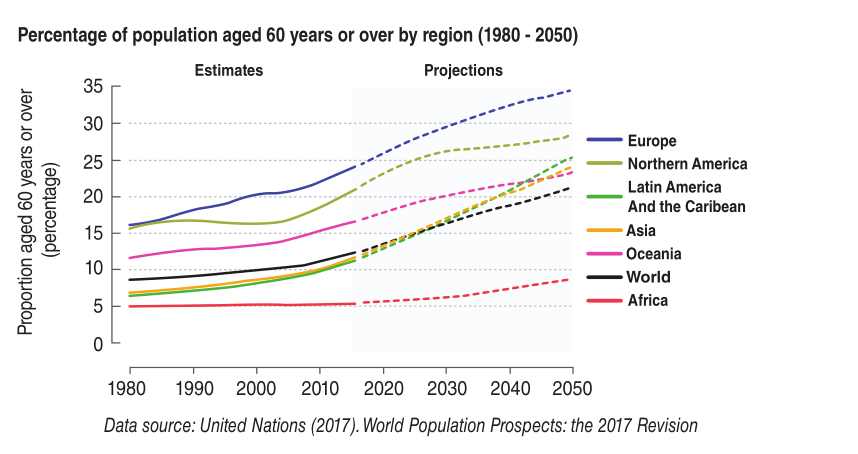
Ory said countries are worried about the dependency ratio-the number of people working versus the number of aged people who are not.
"The US Social Security system was founded in 1930s when there were essentially 17 to 18 workers for each retiree. Today it's down to 3 to 4 workers for every retiree. That is unsustainable based on our current economy and system," Taylor said.
"Now people live to 80, 90 and even 100. The potential care givers are going to be 70 or even 80. What we have is an incredible challenge," said Ory.
"In China, one grandchild faces the challenge of taking care of six seniors-both parents and grandparents. The pressure is tremendous on the young generation," said Yvonne Li, chair of International China Aging Industry Association.
However, the demographic shift does not have to be seen as a gloomy situation. "It can be seen as a wakeup call to come up with different ways to organize society and manage expectations," Ory said.
One major expectation the society has to change is that older people can be in the workforce longer.
"People traditionally retire at 65 in the US. What we are seeing is that some older people are working longer. We need industries and businesses to be more supportive of older workers, respect and value them, not to have them retire so we can hire the new generation," Ory said.
That's exactly what Japan has been doing. The Japanese government requires its companies to let employees stay until 65 if they so choose, and is considering raising the age ceiling to 70.
As a result, more and more older people are staying in the workforce in Japan. About 81 percent of men aged 60-64 had jobs in 2018, a 10 percent increase from 2012. The percentage of working men aged 65 and over reached 33.2 percent in 2018.
In addition, Japan has been encouraging women, who traditionally stayed at home after childbirth, to enter the workforce. Japanese companies are offering flexible hours to enable mothers with small children to hold on to their jobs. A record 77.6 percent of women between the ages of 25 and 34 held jobs in 2018, up 8.5 percentage points from 2012, according to a Japanese government survey.
Ory said technology can help make the workplace easier for older workers. Being productive is also healthier. "You don't want someone from age 60 to 100 to be merely recipients of services. Whether they stay in the workforce, contribute to the community as volunteers or take care of grandkids, make sure older people are valued."








