China's advances in astronomy to bolster talent development









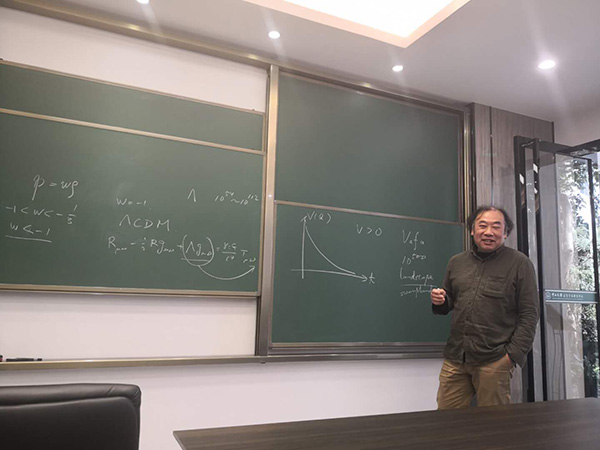
"The first (direct) image of a black hole was published on April 10, and thanks to the prevalence of new media, such as WeChat in China, it triggered widespread discussions on astronomy among people of all age groups," says Wu Qingwen, a professor from the School of Physics at Huazhong University of Science and Technology in Wuhan city, Hubei province.
"I am sure it will help draw more young people to develop an interest and even choose this area as their profession in the future."
Wu notes that 10 years ago, only four universities in China - Nanjing University, University of Science and Technology of China in Anhui's provincial capital Hefei, Peking University and Beijing Normal University - had astronomy departments.
In March, Tsinghua University in Beijing became the latest in the country to have a department of astronomy, following in the footsteps of 10 other institutions of higher education, including Shanghai Jiao Tong University, Xiamen University, Guangzhou city-based Sun Yat-sen University, Yunnan University and Guizhou University.
These departments focus mostly on black holes, dark matter and dark energy, the origins of the universe, and celestial bodies and life.
"First-rate universities must target the most cutting-edge scientific issues," Wu says.
"In the short run, the basic disciplines may not be enough to promote economic development, but in the long term, they are decisive factors for future developments and continuous breakthroughs."
Students today also stand to benefit from the wealth of opportunities created by China's leading role in international collaborations. Nearly all international projects were led by foreign countries until 20 years ago. Before that, Chinese students could only get involved in such projects by studying abroad.
According to scholars, China has over the past decade initiated several influential projects involving international collaboration with world-class scientific goals and equipment, offering students opportunities to participate in international exchange and cooperation.
Meanwhile, the country has also participated in major international projects, and this has provided students with access to cutting-edge resources and techniques. For example, in March, China became one of the seven countries that make up the Square Kilometre Array, a planet-scale array of radio telescopes that is 100 times more sensitive than the largest radio telescope in the world.
"China's involvement in such historical international collaborations will open a new chapter in our understanding of the universe and lead the development of radio astronomy in the coming decade that will contribute to the country's grooming of first-class talent in this field," Wu says.