Stability and new opportunities raising living standards









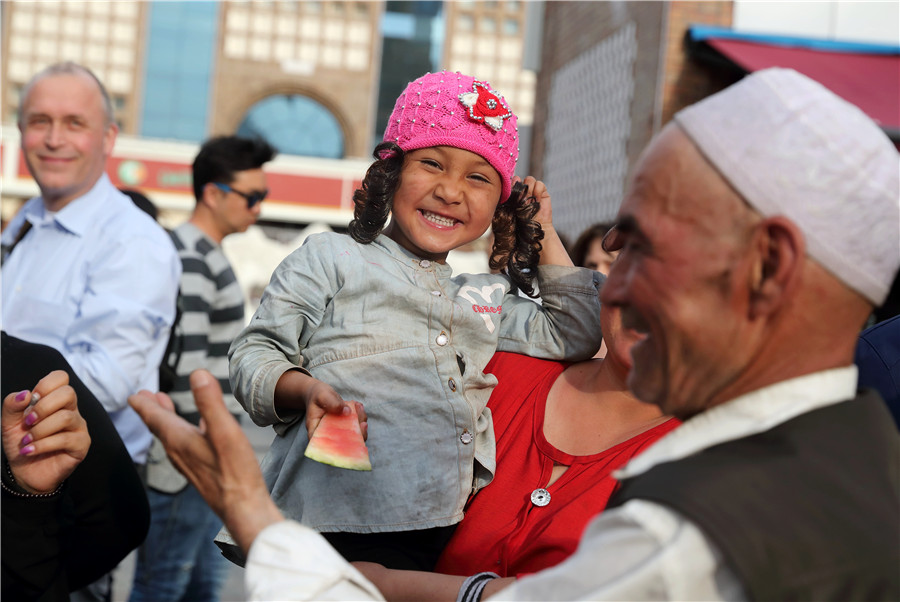
Free education
According to Erkin, to ease the financial burden of education costs the regional government provides access to high-quality education for all children, particularly those from impoverished families in southern Xinjiang.
It has invested about 12 billion yuan in education in recent years, expanding the nine years of free education (consisting of primary and junior middle school education) required by the central government into a 15-year system that includes three-years of preschool and three-years of high school education.
After years of effort, almost every village in southern Xinjiang now has its own kindergarten, providing local children with preschool education.
In a beautifully decorated classroom at a kindergarten just a few hundred meters from Abdurehman Yimin's home, scores of children danced as a radio played Uygur and Mandarin songs.
Nurbeye Kaisa, the kindergarten's director, said the small facility was built in 2017, thanks to government investment of 4 million yuan. Now employing 18 teachers, the kindergarten provides services for 180 children ages 4 to 6, all from the Uygur ethnic group that makes up the majority of the local population.
Parents send their children to the kindergarten in the morning and pick them up in the afternoon. The children can spend the whole day at the facility enjoying different kinds of courses or activities conducted in both the Uygur language and Mandarin, such as singing, dancing, painting, playing games and making cookies. They also receive two meals and a dessert every day.
"Despite their young age, most of the children can communicate with the teachers or with each other in the two languages," Nurbeye said.
"Before the kindergarten was built, the local children were either cared for by their aging grandparents or they accompanied their parents to work on farms or in factories, which meant their safety and health could not be guaranteed," she said.
"At the kindergarten, they can have classes, meals and rest regularly in a cozy environment, and it doesn't cost (the family) a penny," she said, noting that the annual 2,800 yuan tuition fee for each child is paid by the local government.
Abdurehman's youngest grandson attends the kindergarten. "Thanks to the kindergarten, my grandson has a very good time every day, and he learns a lot of useful things," he said.
Aybek Askhar in Beijing contributed to this story.
- China ready to actively consider granting unilateral visa waiver to British people: Xi
- Xi sees win-win results as essence of China-Britain economic, trade cooperation
- Xi says China will never pose threat to other countries no matter how it grows
- China, Britain agree to develop long-term, stable comprehensive strategic partnership
- Chen Xuyuan, Li Tie banned for life from football
- China executes 11 criminals of northern Myanmar telecom fraud groups