Electric startups failing to spark excitement among investors









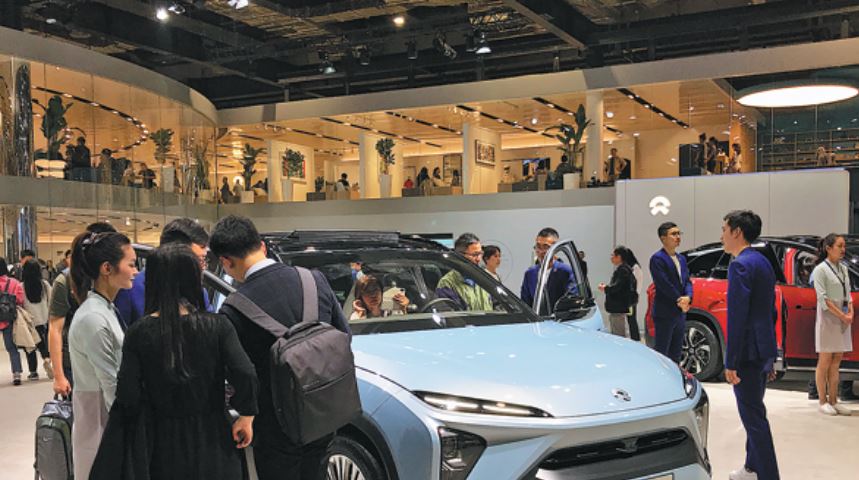
Chinese electric car startups are having a tough time raising money to turn their blueprints into reality as their vehicles are increasingly alike and those on the market fail to meet expectations.
They raised just $783 million as of mid-June 2019, compared with $6 billion for the same period last year, according to Reuters citing data from PitchBook. For 2018, the total funds raised stood at $7.7 billion.
"It is challenging," a Hong Kong-based banker told Reuters. "If you can get a meeting with investors, you can always tell a story, but some don't even reply to your requests for a meeting."
He said at least a dozen electric carmakers approached him for new funds. But he had to pass on most of them as they were not able to set themselves apart from the crowd.
The number of well-known electric car startups is at around 50 in China. However, the total number of such companies could total about 330, according to government data.
The banker's concerns reflect what his profession describes as increasingly tough funding times for Chinese electric carmakers.
They must jostle for attention in an increasingly homogeneous sector and convince potential investors about future profitability. Also, the Chinese government is expected to phase out financial stimuli by the end of 2020.
"All of them will use words like human-centered, another living space, autonomous driving and facial recognition and all of them claim to feature big displays and update-over-the-air," an industry analyst told China Daily.
Despite their rosy depictions, there are too many uncertainties involved in the process. It starts with a company telling a story, producing a sample car and raising funds, to their production and sales in the market, he said.
Statistics from the China Passenger Car Association show that the most popular model from startups, the Xpeng G3, saw its sales stand at 2,704 in May. It was followed by WM EX5, whose sales were 2,056, and the Nio ES8 at 1,068.
Those brands were the top three of 14 startups which sold any car in the month. The last-placed startup delivered six. In May, the total new energy vehicles sold in China stood at 100,000 units.
Surviving in this funding environment requires much cost discipline, Daniel Kirchert, CEO of electric car startup Byton, told Reuters. "Given the current situation, it is not enough for any startup to come up with good products and be fast to market. At least it's equally important to manage cost. Not only fixed costs but variable cost," he said.
Byton, which is backed by State-owned automaker FAW Group and battery supplier CATL, is one of a few electric carmakers with a fundraising round in sequence, seeking $500 million.
Kirchert told China Daily that the fundraising is going smoothly and the round will be completed around the middle of this year.
He said the company's first production model, the M-Byte SUV, will premiere in the third quarter. Volume production will start by the end of 2019.
Others include Leap Motor, which is seeking $372 million. CHJ Automotive is reported to be in the process of raising $300 million from investors including Meituan.
Those with funding under their belts this year include Baidu-backed WM Motor Technology. They closed a $446 million round in March, according to PitchBook.
But overall, industry funding prospects are much bleaker. As Tesla and Nio struggle, the slowdown in the new energy vehicle market is putting investors on their guard.
Nio is probably the best-known name among Chinese startups. But its shares traded at New York have been hit hard.
Its first-quarter sales were 3,989 units, 50 percent less from the previous quarter. Its net loss stood at 2.65 billion yuan ($385.75 million), down 32.8 percent from the same period last year.
Its reputation has been further hurt after several vehicles caught fire.
The new energy vehicle segment is slowing down as well. Their sales in China saw a mere 1.8 percent growth year-on-year in May. The growth rate was 18.1 percent in April and 85.4 percent in March.
"We are seeing investors become more cautious, selective and keenly focused on the front-runners. I think this trend is likely to persist," Brian Gu, president of Xpeng and a former senior executive at JP Morgan, told Reuters.
Yale Zhang is managing director of Shanghai-based consulting firm Automotive Foresight. He said despite the plethora of electric car startups in China, no more than two or three will survive. This is because competition will intensify when Tesla rolls out localized models and the government withdraws subsidies.