Cooling down with herbal drinks









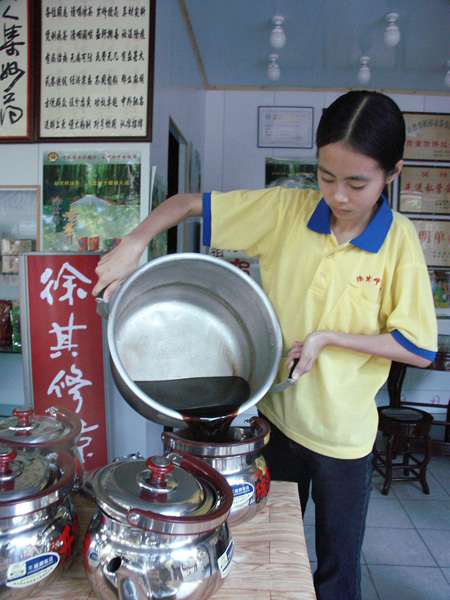
In recent years, the herbal infusions have even been commercially distilled and are sold in packets of easily dissolved crystals, just like instant coffee.
Another famous infusion is wuhuacha, the five-flowers tea, made from honeysuckle, chrysanthemum, Chinese locust, red cotton tree flowers and the kudzu flower.
In my own childhood, I remember my village Cantonese grandmother feeding me all sorts of evil concoctions. A more pleasant tasting one was the baizicao tea which even smelt faintly floral and was supposed to chase away the summer vapors. Growing up in Singapore, that meant we drank it all year round.
The herbal brew that sent me hiding under the staircase was an intensely bitter brew made from the tiny dried flower buds of Cleistocalyx operculate. It had a beautiful Chinese name, shuiwenghua, which roughly translates to "flowers of the water scholar".
Its literary beauty was totally lost on me.
This was forcibly fed to me whenever I showed signs of fever and sunstroke, which was often, and I never failed to break into a sweat after drinking the brew. Perhaps it was sheer terror.
Similar stories are told by my friends.
One was made to drink a series of bitter concoctions after she was diagnosed with polio and western doctors told her mother there was nothing else they could do.
Her determined mother consulted a Chinese physician in Chinatown who prescribed a routine of herbal brews. They worked. We never knew she had polio until she told us.
Miraculous cures aside, most herbal teas are roughly divided into four categories, according to their effectiveness.
The first group is the antitoxin teas, which clears accumulated heat in the body and is suitable for those who are easily irritated. The main ingredients include honeysuckle, chrysanthemum, wild magnolia and so on.
The second group of teas is for those susceptible to summer colds and sniffles. The signature ingredient is banlangen, the indigo root, touted as the miracle herb during the SARS epidemic in 2003.
Another group of teas is more for autumn consumption when the weather becomes very dry and coughs and throat irritations are common. They make use of pear leaves, snow fungus and other soothing ingredients.
Finally, the last group of teas is those that clear "wet heat", a condition that arises from too much spicy and fried food, and high fructose fruits such as mangoes and lychees, resulting in halitosis. These teas use honeysuckle, chrysanthemum and dessert mushrooms to best effect.
There are some things modern science is still discovering about Chinese herbal teas. To the Chinese, however, the proof is already in the drink.
paulined@chinadaily.com.cn