


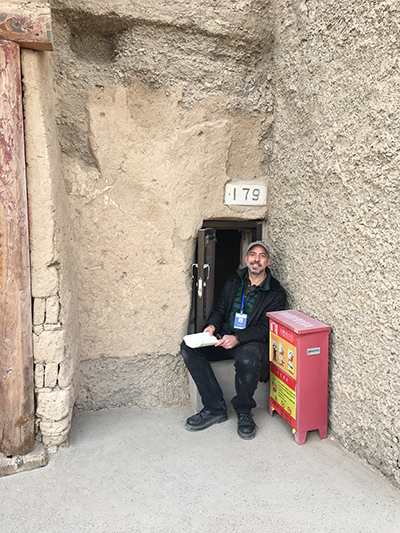
To protect and serve
The Dunhuang Academy was founded in 1944 by the Chinese government to protect the Mogao Grottoes.
In 1900, 60,000 ancient documents, in many different languages from along the Silk Road, were discovered in Cave 17, also known as the "library cave". The manuscripts, both religious and secular, were encyclopedic in nature and spanned almost a millennium.
"It's a unique ethnographic recording," he says. "The manuscripts are like slices of time. We see people's daily lives and social relationships in fantastic detail."
However, upon hearing the news, foreign explorers and archaeologists swarmed to the site, and many manuscripts were taken to Europe. For example, the Vajracchedika sutra, which bears the date 868 and is the world's earliest-known printed work, now resides in the British Library.
Though that period of history provided an opportunity for Western academia to understand Chinese and Central Asian cultures, Schmid notes that this is not an excuse to condone their behavior.
"Their approach to obtaining antiquities belongs to a different era that no one would deem acceptable in 2019," he says.
Less than one-third of the remaining Dunhuang manuscripts are currently housed in China. The lack of materials was indeed a threshold for relevant research in the country, and there was common saying: "Dunhuang belongs to China, but Dunhuang studies belong abroad."
However, things began to change after the 1990s, Schmid says.
"Accessibility has been greatly improved by the digitization of manuscripts, material objects and caves ... and databases containing the scholarship and research of Dunhuang materials," he explains.
"Now, individuals all over the world can access Dunhuang resources in ways unimaginable to scholars from the 20th century."
The global cooperation program, the International Dunhuang Project, is now a foundation for such joint research. The academy signed memorandums of understanding for cooperation with 10 overseas institutions in 2018 alone, including the British Library, University of California, Berkeley, and Pritzker Art Collaborative in Chicago. Also, 17 international symposiums were held by the academy last year, attracting 58 scholars on Dunhuang studies from around the world.
Additionally, the e-Dunhuang project, a database established by the Dunhuang Academy, has also taken high-definition pictures of about 220 caves, 30 of which are online for public viewing.
"Schmid is crucial in building our connections with European and US research institutes," says Mao Ming, a fellow researcher at the academy.
"It started with a pilgrimage, and he hasn't lost that passion, even after three decades. I admire his diligence in his studies."
Another researcher, Zhang Yuanlin, who is in charge of the database of the academic resources, says: "As someone devoted to Buddhist images and religious artworks, Schmid has a particular preference for Dunhuang. His original views are creative and widely recognized in academic circles."





