



Realty check: Leverage is under control









Solid fundamentals, tight regulations, sales pickup shield indebted property industry from default risks
China's real estate industry may be staring at what some may label as a monstrous financial problem.
According to estimates of the Evergrande Research Institute, real estate developers in China will need to repay debts of 6.1 trillion yuan ($887.4 billion) this year and 5.9 trillion yuan in 2020.
What's causing concern in some, not all, financial circles is that both these figures are more than double that last year (2.9 trillion yuan).
Such staggering indebtedness may ring alarm bells anywhere else in the world, but in China, there's no panic, only cautious optimism, experts said.
How come? Any financial risks that may arise from high leverage of China's real estate industry would be kept under control as the fundamentals of the property market remain rock solid and the necessary financing regulations are in place, they said.
Supervision over new forms of leveraging channels, however, should be strengthened, they said.
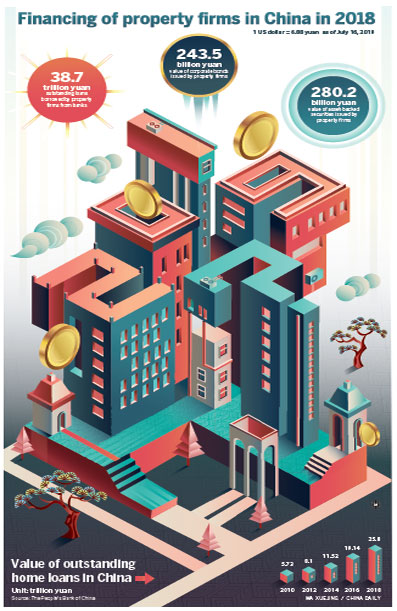
Leverage refers to the amount of debt a firm uses to finance assets. In the context of a property firm, high leverage would mean its projects have more debt, mostly in the form of bank loans, than equity.
When a property firm borrows heavily to build new projects, but is unable to repay in time due to poor financials, or paucity of buyers, or sluggish sales, or other market forces, it will likely default. That is a potential financial landmine as it could spark systemic risks, given the pivotal role of commercial banks in a financial system.
Financial risks of the real estate sector are also reflected in the rapidly rising mortgages of Chinese families. From 2008 to 2018, China's outstanding amount of residential mortgages surged from 3 trillion yuan to 25.8 trillion yuan, pushing up the household debt-to-GDP ratio to 53.2 percent by the end of last year, according to the People's Bank of China, the central bank, and the Chinese Academy of Social Sciences.
But related risks are still controllable as the ratio is still below the global average level of more than 60 percent and far below the approximately 95 percent in the United States on the eve of 2008 subprime mortgage crisis, analysts said, adding that it is still necessary to rein in the growing residential mortgage burden.
















