


Digital drive opens more doors to grottoes









As a major cultural and tourist destination, Dunhuang's Mogao Caves suffer from what many other attractions will envy-too many visitors.
The crowds heading to the iconic repositories of ancient Buddhist art constantly threaten the fragile cliff-side environment on the fringe of the Silk Road oasis, according to Zhao Shengliang, director of the Dunhuang Academy, which manages and studies the site and its relics.
To mitigate the impact of human activity on the grottoes in Gansu province, which face the Gobi Desert, the academy has set limits on visitor numbers. Two ticket categories are sold every day. The first type is limited to 6,000 tickets and allows holders to access eight of the 492 grottoes containing major Buddhist art, while the second category allows up to 12,000 visitors to enter four of the caves. More than 100 of the caves at the UNESCO World Heritage Site are suitable for public access on a rotational basis as part of conservation measures.
Wang Xiaowei, director of the site's monitoring center, said the caves are at full capacity during the peak summer holiday season.
"In line with protective measures for the site, we take a preventive approach that encompasses tracking the natural and human impacts," Wang said.
From high humidity levels to ground movements generated by visitors' footsteps, center staff members are on alert for any risks to the condition of the relics, which are monitored via a central command room. Command room staff can order the closure of specific grottoes to prevent any negative impact on the artifacts.
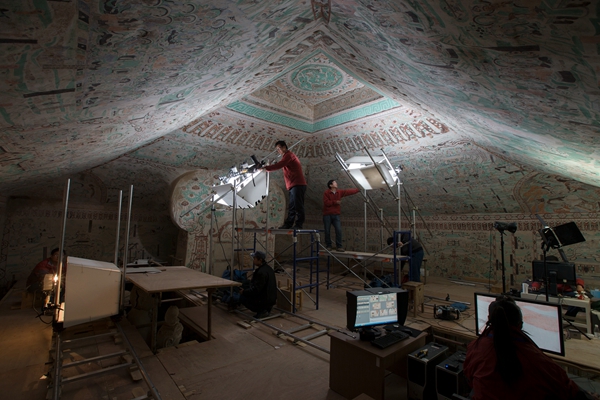
Faced with the physical and geographical limitations of the site, the academy is pushing ahead with a major digital-imaging drive to archive the Buddhist relics so that more people can access and appreciate them. Building on the groundwork of the late 1990s and collaborations with international cultural institutions, the digital archiving of 221 caves has seen completed, according to Wu Jian, director of the academy's cultural relics digitization institute.
Five teams of four imaging professionals record the Buddhist art with advanced photography equipment before the images are processed by another specialist team at the academy. Viewers can easily access the results online, including English-language versions, Wu said.