



A blessing in tech disguise?









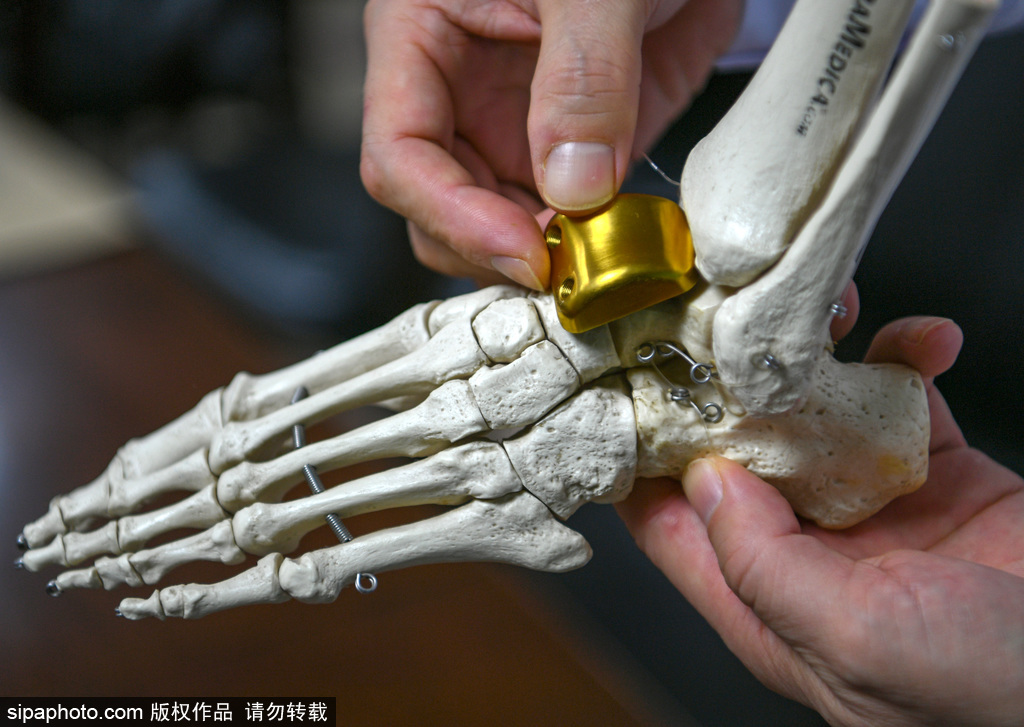
The first time I heard about 3D printing's medical application in China was in 2013, when the orthopedics department of Peking University Third Hospital, a top hospital in China, announced promising results of a clinical trial using enhanced titanium implants produced by a 3D printer.
Since 3D printing can virtually produce implants in any shape as a digital model instructs, 3D-printed implants match better with the bones around them than traditionally manufactured ones, which are usually geometric patterns and cannot attach to bones firmly without additional cement, screws or fixing plates.
In 2016, the hospital doctors implanted 19 centimeters of 3D-printed spine parts to replace a patient's cancer-riddled vertebrae, saving his life. The hospital co-developed those lifesaving 3D-printed implants since 2009 with AK Medical Holdings Ltd, a domestic leader in orthopedic joint implants market. In 2015, the company became the first in China to receive market approval for 3D-printed metal implants.
However, the printer used at that time was imported.
Six years on, the company has grown to co-develop with Tsinghua University China's own version of 3D printers and printing materials for orthopedic implants, which are currently under manufacturing validation, and probably will be used in production lines next year, I was told.
That reflects the bigger picture of how fast 3D printing develops and applies in China.
It is no longer seen as a geek technology to print novel tools or models, but something that can upgrade manufacturing and can make people's life better.
Its medical applications are a good example.
Before surgeries, the technology can be used to replicate patient-specific organs for doctors to design and simulate surgeries. Such preparation, more accurate than the traditional way of using two-dimensional medical images, can help speed up procedures, minimize patient trauma, and enhance treatment outcomes.
The use of 3D-printed surgical guides, and the medical device that helps doctors during surgeries to increase the accuracy of implant placements, make doctors' operation even more accurate, while 3D-printed implants and prosthesis, shaped to fit perfectly with a patient's anatomy, are more stable and comfortable than traditional ones.
3D printing can also be used to produce precisive medical devices and gadgets, and help with new drug development.
Perhaps that is one of the reasons why Xi'an Bright Laser Technologies Co Ltd, a leading 3D printing solutions provider in China, is so widely recognized.
The company was among the first batch of companies to receive the regulator approval to list on the Shanghai Stock Exchange's sci-tech innovation board, commonly known as the STAR market.
It boasts a complete technical solution of metal additive manufacturing and repairing for customers, including customized products, equipment, raw materials, software and technical service.
Most importantly, with strong independent research and development capabilities, it has invented a dozen of metal 3D printing equipment sets, taking a lead in domestic market.
In the world, researchers also are making efforts to push forward the development of 3D printing technology.
As technology evolves, perhaps bioprinting functional organs, one of the most exciting applications of 3D printing, is not that far away.
Not a day passes without some news about breakthroughs in 3D printing using living cells.
A few days ago, 3DBio Therapeutics, a New York-based biologics and bioprinting company, announced its AuriNovo, an investigational combination product using patients' own auricular cartilage cells to 3D-bioprint living, full-sized ear construct, received Orphan Drug designation from the United States Food and Drug Administration, a status assigned to treatments developed for rare conditions.
In October, scientists in Austria were reported to have developed a high-resolution 3D printing technique that uses a novel bioink to embed cells in a 3D matrix.
In April, Israeli scientists in Tel Aviv reportedly 3D-printed an artificial heart using a patient's own cells. The artificial heart was complete with cells, blood vessels, ventricles and chambers, although only of the size of a rabbit's heart.
Think about this: 3D-printed organs, which are customized and constructed with patents' own cells, are transplanted into patients in dire need, saving typical problems related to traditional organ transplants, such as lack of donor sources and immunity resistance.
Perhaps, in the not too distant future, this could well prove a blessing for patients suffering from organ failures.


















