


In ancient times the city of Changshu had a poetic name, Qinchuan, meaning guqin stream, the guqin being regarded by Chinese as the most elegant of all their musical instruments, producing delicate music from seven strings. Later guqin would come to denote elegance.
Qinchuan originates from the river running through the north and south of Changshu, with seven lateral tributaries resembling the seven strings on the ancient instrument. The canal that crosses the city for more than 1 kilometer is thus called the Qinchuan River, also known as Changshu's Mother River.
Strolling in the alley along the Qinchuan, visitors can enjoy a view of Jiangnan-style houses with white walls and gray tiles, and small bridges connected to the road every other section. Changshu used to have fewer roads. Farmers often paddled boats to hawk along the river and those living in houses by the river often dropped bamboo baskets from windows and used them to buy things.
In 758 during the Tang Dynasty (618-907), Jiangnan East prefecture was abolished and was divided into Zhejiang East prefecture, Zhejiang West prefecture, and Fujian prefecture. Among them, Zhejiang West prefecture was under the jurisdiction of present-day southern Jiangsu, northern Zhejiang, Shanghai, and Huizhou in Anhui province. This area is roughly equivalent to what today is Jiangnan (south of Yangtze River). Its wealth in resources and human development accumulated after the Eastern Jin Dynasty (317-420) when northern China was run by non-Hans, and the Han aristocrats fled and settled in Jiangnan. From then on the region became synonymous with prosperity and poetry.
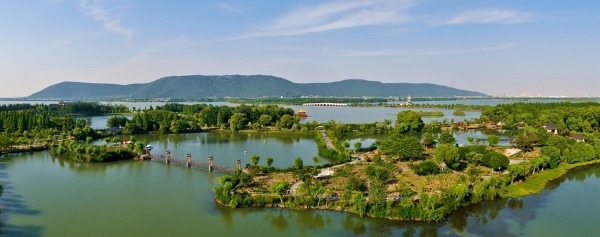
Many poets have written of the region's scenic beauty, Yushan Mountain perhaps being the jewel in the crown. Yushan, the only mountain in the Changshu urban area, was originally called Wumu.
At the end of the Shang Dynasty (c. 16th century-11th century BC), the leader of the Zhou clan, Duke Danfu, regarded his grandson Ji Chang, son to his third son Ji Li, as the apple of his eye. The duke intended to pass the throne to Ji Li so his grandson would eventually reign. Aware of their father's wish, the duke's eldest son Tai Bo and his second son, Yu Zhong, moved from their capital to what today is Changshu. When Yu Zhong died he was buried on Wumu Mountain, and in honor of the sage who brought advanced farming culture here the name of the mountain was changed to Yushan.





