



Rare horses ride out the wild winter









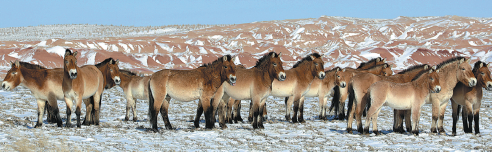
URUMQI-The Junggar Basin in the Xinjiang Uygur autonomous region usually sees its lowest temperatures and a lack of forage from mid-November to the middle of this month, the most difficult time of the year for the endangered Przewalski's horses.
The basin is the original habitat of the rare horse subspecies, which disappeared due to rampant hunting and environmental problems. The government imported Przewalski's horses in the 1980s, and released some of them in the Kalamaili Nature Reserve in the Junggar Basin.
"A total of 146 wild horses are living in the area. They belong to 20 families. The bigger families consist of one male horse, several mares and some foals, while the small families usually have two or three in the group," said Joldebek Ruhay, a worker at the nature reserve.
Xinjiang wildlife authorities have set up a monitoring station in the nature reserve to keep a close eye on the Przewalski's horses. Rangers and 14 management personnel look after the animals.
A 50-hectare enclosure has been established not far from the monitoring station for horses that need extra care. To help the wild animals survive the winter, the nature reserve provides forage for the horses to supplement the feed, Joldebek said.
The temperatures drop to as low as-20 C in winter, providing another major impediment to survival.
Arqin Waldan, a veteran worker at the nature reserve, said 30 foals were born between May and July. "They were weaned around November, but the weather became cold from then on. Less grass and water often pose a risk to the foals."
During the winter months, rangers provide water and 180 to 200 bales of clover for the horses every day. All the wild horses in the enclosure will be released around mid-March.
"Such artificial intervention can help the expansion of the Przewalski's horse population. After the population becomes stable, the wild horses will eventually live on their own in the wild," said Ayijan Yeriken, who works at the nature reserve.
The number of Przewalski's horses has risen to 430 in Xinjiang, accounting for 70 percent of the population of the subspecies in China.
The horses-which have a short muscular body, stiff mane and are tan-colored-are the only surviving horse subspecies never to have been domesticated.
After the subspecies disappeared from the basin, the government started a breeding program in the 1980s using horses from Britain and Germany to rebuild the population. There are only 2,000 Przewalski's horses in the world.
Xinhua


Today's Top News
- Kite fans from all over swoop in for a flying visit
- Japan's easing of weapons export restrictions opposed
- Harmonious growth model nurtured
- Travel demand for Japan slumps amid strained ties
- UN urges freedom of navigation in Hormuz
- Smearing speaks more about the smearer: China Daily editorial


