



Taking wing amid turbulence









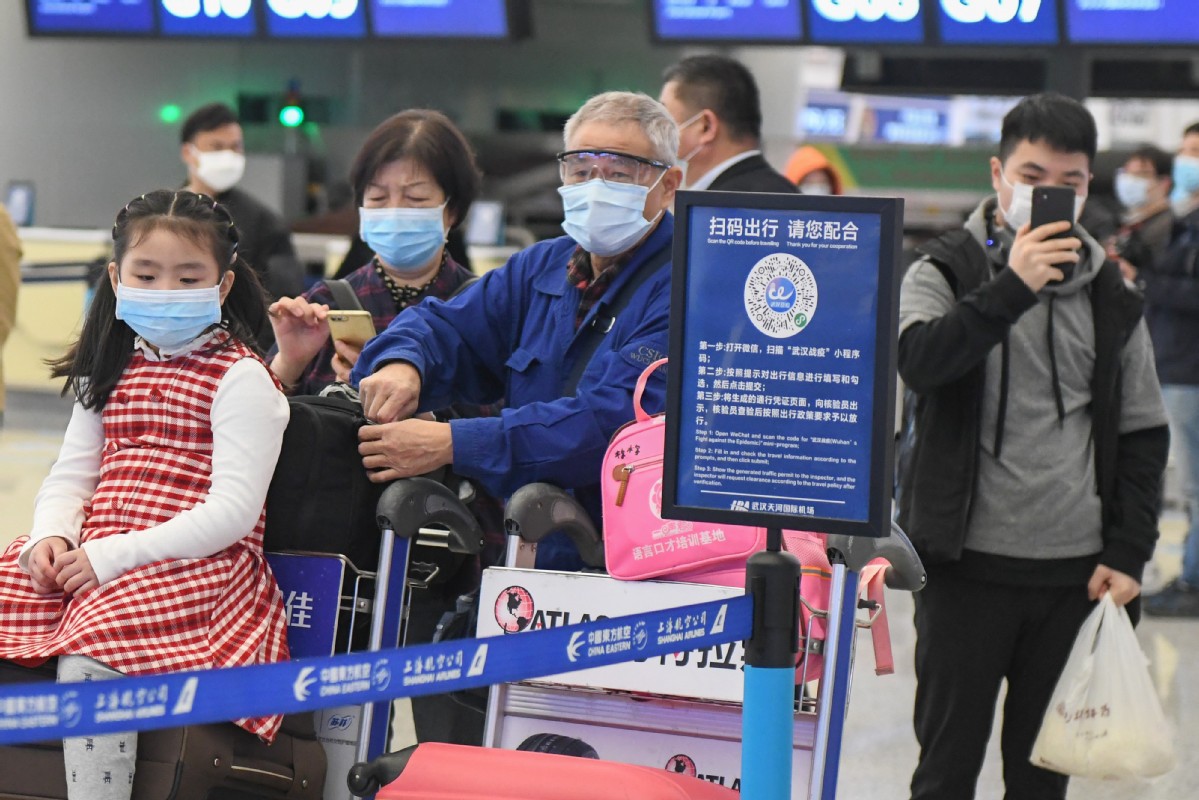
Now, each Chinese carrier operates only one international flight to one country once a week, according to the requirement of the Civil Aviation Administration of China.
With their international flight capacities having been cut to a fraction of their normal level, Chinese carriers are expected to face their first annual loss since 2008, and it is just a matter of the extent of the loss that remains to be seen, industry experts predicted.
"With most industries experiencing a slowing revenue growth or loss, they are likely to control the business travel costs of their employees. This will result in declining demand, and carriers will have to offer highly competitive flight ticket prices," said Yu Zhanfu, partner and vice-president of consultancy Roland Berger China.
"In addition, most employees have been familiar with work-from-home and digital communications, and people have increasingly acknowledged remote working technologies. It could irreversibly cut down some business travel demand in the long term," he said.
"The aviation sector will fluctuate along with the economic cycles, geopolitics and major global events. Risk confrontation is the long-term theme of the aviation industry."
As the most severe crisis for the aviation sector in modern history, the outbreak may catalyze new patterns of business among industry players. Less competitive carriers will be easy pickings for the stronger players. But ultimately, with the alleviation of overcapacity, it will benefit those who survive and ride out the crisis, consultancy Roland Berger said in a report.
Woo Kee-hong, president of Korean Air Lines, the largest carrier of South Korea, said the situation could get worse at any time, and it could threaten its survival. Korean Air said since mid-April, more than 70 percent of its staff started to take a half-year furlough. They will receive 70 percent of the regular salary, and most of the funds come as part of South Korean government's financial aid or bailout package.
Flybe, Europe's largest regional airlines with a history of 41 years, has recently gone bankrupt. Scandinavian Airlines has temporarily laid off 10,000 employees, or 90 percent of its total workforce.
Elsewhere, global airlines are endeavoring to stay afloat by maximizing cargo freight transport operations using commercial aircraft, since the passenger and cargo markets are polarized in terms of performance. Most passenger aircraft have been grounded and freighters have been busy.
The epidemic has reduced about 90 percent of flight capacity between Europe and Asia, and caused a major shortage of cargo capacity. COVID-19 has also prompted an increasing demand for medical equipment that necessitated cargo flights connecting the United States, Europe and China.
United Airlines is adding its cargoonly flights between China and the US, to ensure vital goods reach those who need them. This month alone, United plans to operate 289 cargoonly flights between the two countries, taking the total number of flights since April to more than 400.
The cargo-only services connecting Chinese cities like Beijing, Chengdu, Shanghai, and Hong Kong with US cities like Chicago, Los Angeles, San Francisco and Washington DC are operated using Boeing 777-300 and 787-9 aircraft from United's fleet.
US carrier Delta Air Lines restarted its regular flights between Shanghai and Detroit with cargo-only services, as demand for medical supplies continues to grow in the US.
Since late March, KLM Royal Dutch Airlines started to operate two weekly cargo flights to Beijing and three weekly cargo flights to Shanghai, using Boeing 787s and 777s.
"We are seeing an enormous increase in healthcare shipments. In a number of other sectors such as automotive, fashion and flowers, we are seeing a sharp decline, but that decrease is not as fast as the extreme capacity reduction. Stories that there would be an extreme peak in air freight transport are not correct," said Adriaan den Heijer, executive vice-president of Air France KLM Martinair Cargo.
Lin Zhijie, an aviation industry analyst and a columnist at Carnoc, one of China's largest civil aviation websites, said usually, 70 percent of cargo shipments are done using the belly-hold operations of passenger flights globally, and the corresponding figure for China is 82 percent.
"In fact, the transport volumes of both passenger and cargo markets went down, but the decline of the cargo market is much less. Transporting medical supplies will help carriers to make some profits, but the limited number of flights and transporting volumes won't help much to lift their revenues," he said.
- Passenger flights in China cross 10,000 mark
- It's all yours up in the air — for a pretty penny
- China sees intensive technical progress in constructing smart airports
- China details measures to improve business environment in civil aviation sector
- China to further support small, medium-sized airports in remote regions








