
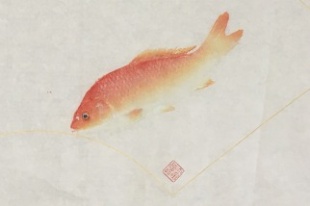



Paintings to scale a treasured traditional art form










The origin of fish printing remains unclear.
According to Yu, there is no written record of the art form in historical records, and no ancient works have been found.
But experts believe that the art form might date back to ancient China, as the techniques resemble that of stone rubbings from the Song Dynasty (960-1279). For instance, both art forms use a dabber.
The art form is now known best in Japan as gyotaku, meaning fish rubbing. In China, a small group of practitioners are working to promote the art form.
Yu estimates that fewer than 1,000 people in the country have mastered the skill.
"The Chinese style of fish printing has influences from traditional Chinese painting. Upon completing the printing, usually we would adorn it with drawings of plants and landscapes, calligraphy and also stamps and seals," Yu says.
The Chinese aesthetics are also reflected in the color choices.
While most of the time the artists would select colors to create the original shades of the fish, works commissioned by clients would often use red, as many consider the red koi fish to be auspicious.
Yu is currently working on a 20-meter scroll that incorporates 22 varieties of fish that inhabit Shandong's Weihe River.
Yu led the successful effort to include fish printing on Gaomi's intangible cultural heritage list and the equivalent list of Weifang city this June.
"To be honest, fish printing does not have a standardized system like Chinese watercolors or calligraphy. There are only a handful of practitioners around the country. So each year we will meet up a few times to discuss the techniques, tackle problems together, learn and progress," Yu says.
Yu now has his own studio in Gaomi that aims to promote fish printing. He occasionally hosts short-term training courses in Beijing. So far, more than 100 people have learned the skill from him, either in one of these courses or at his studio.


















