Stricter disinfection rules in effect for cold imported food









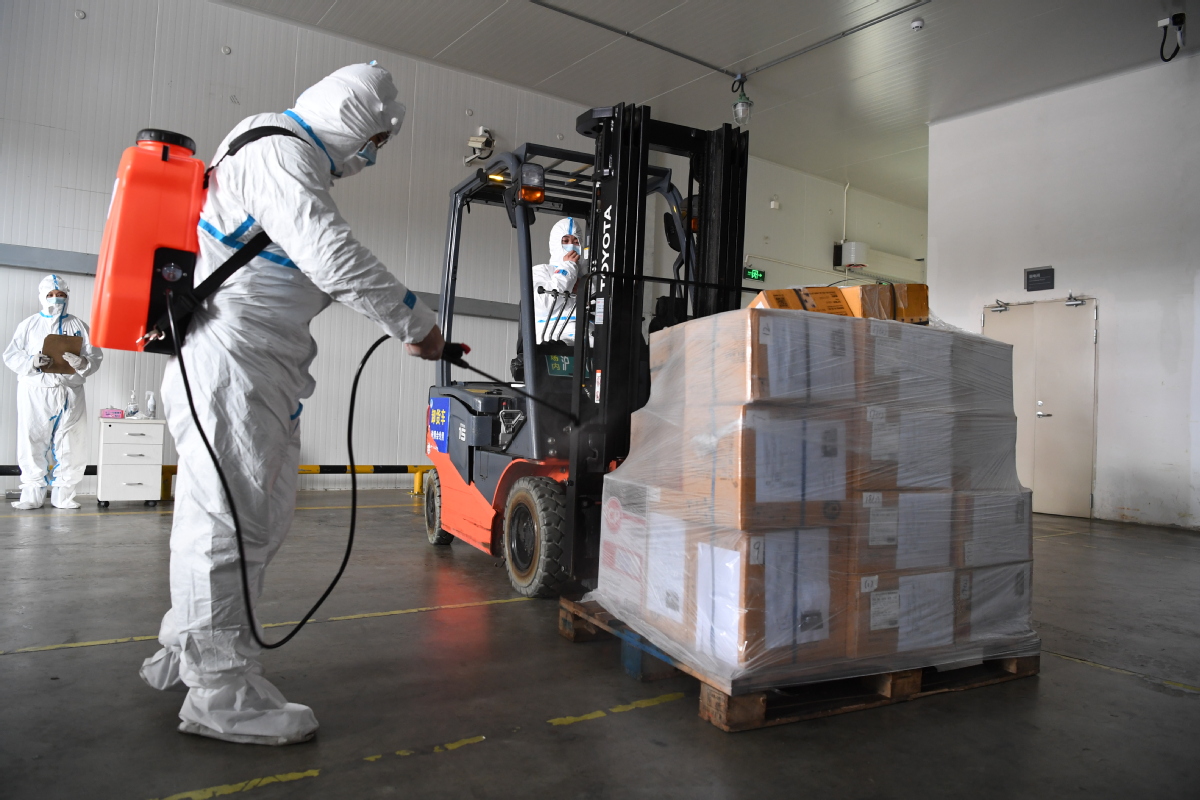
China is doubling down on efforts to stem the transmission of the novel coronavirus through imported cold products, requiring thorough disinfection of such shipments before they come into contact with domestic workers.
The heightened precautions were announced in a notice, released by the State Council's Joint Prevention and Control Mechanism on Monday, after Tianjin reported a confirmed case of COVID-19-a worker at a local frozen food company-on Sunday. A string of domestic infection clusters this year have been linked to cold-chain imported food.
With regular nucleic acid tests in place on imported cold goods and workers involved in handling them, the notice highlights the significance of comprehensive disinfection of storage facilities, transport vehicles and packages of the products.
Sellers of cold-chain imported food must present disinfection certificates before their products are allowed to enter the market, according to the document.
In order to reduce disruption to normal logistics and supplies, disinfection should be carried out after nucleic acid samples from overseas products are collected, and should be conducted only once in most cases, it said.
"Disinfection service providers should record their work in detail and the records and paperwork should be kept for at least two years," it added.
The document also stresses improving the capability of tracing the origin and flow of cold-storage products and investigating and holding shipments from unspecified sources.
"The goal is to be safe, efficient, speedy and economical," it said. "While ensuring the safety of imported cold products, we are also aiming to increase efficiency during customs clearance, avoid backlogs and secure the stability of the industry chain."
Global experts have long suspected the virus' ability to travel and be transmitted through cold-chain products, but evidence has not been easy to nail down.
The Chinese mainland has detected at least 16 cases involving frozen imports testing positive for the presence of the novel coronavirus since July, prompting customs officials to ramp up supervision over foreign goods and suspend imports from a number of manufacturers.
In October, the Chinese Center for Disease Control and Prevention said it isolated living novel coronavirus on the outer packaging of frozen food when investigating the source of an outbreak in Qingdao, Shandong province. The discovery, a world first, proved that contact with frozen food packaging contaminated by live virus could cause infection.
Later that month, a Chinese research team consisting of university researchers and CDC experts concluded from epidemiologic history and data analysis that the outbreak that took place in Beijing in June was likely to have been triggered by imported seafood, and cold-chain transportation could be a new route of transmission for the virus.
The confirmed patient in Tianjin is a loading dock worker who handled frozen pork from Germany that arrived in Tianjin on Oct 19. The shipment, part of which was sent to Shandong, tested positive for the virus on Saturday.
The Tianjin government said on Monday evening that it found a new asymptomatic patient on Monday-a truck driver who lugged goods from a frozen storage cluster in the city's Binhai New Area on Thursday. The patient with the previously confirmed case also worked there but handled a different set of goods.
Gu Qing, deputy director of the Tianjin Health Commission, said two areas in the Binhai New Area would be classified as a medium-risk region starting on Monday midnight. Other parts of the city remained at low-risk.
All 70,000-plus residents of the medium-risk area will take nucleic acid tests overnight and those who intend to leave for essential reasons must present nucleic acid test results taken within seven days, he added.
Liang Chunzao, deputy director of the Binhai area, said all 364 workers at the affected cold storage cluster have been tracked down and their test results were negative.
The area is home to 39 cold storage facilities, housing 126,000 metric tons of cold-chain products, according to Liang.
"We have assembled a joint testing team in order to complete nucleic acid tests on all cold imports as soon as possible," she said.






- China sees 6.522 billion domestic tourist trips in 2025
- China to boost extreme weather forecasting capabilities in 2026
- China hits 469m motor vehicles in 2025 amid drop in dangerous driving cases
- Fujian deepens cross-Strait integration with Taiwan through infrastructure and cultural initiatives
- Winter sports push tourism in NE China's Jilin
- 'Beijing Rocket Street': A launchpad for accelerated development