


Revealing glories of the past









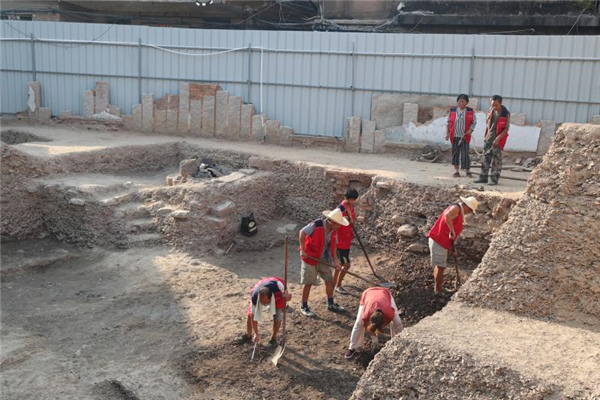
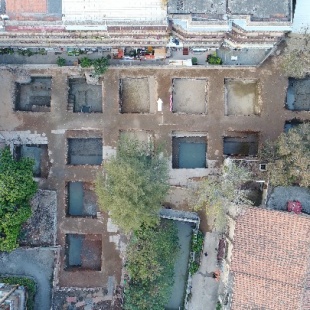
"With the help of historical literature, we can basically infer the existence of the two sites, identify ranges of them and their construction techniques, which are similar to some ancient constructions we had found in Luoyang city, Central China's Henan province," he adds.
According to An Jiayao, director of the Silk Road Archaeological Specialized Committee of the Archaeological Society of China, "The existence of the official sites shows the political status of Quanzhou in ancient times, besides its important role as a commercial center."
According to historical literature, Quanzhou in the Song and Yuan dynasties was a port city with prosperous trade and cultural exchanges. "A large number of construction remains, like the stone pillar with features of Hinduism in Kaiyuan Temple, show Quanzhou's role in cultural communication," says Hang Kan, a professor from School of Archaeology and Museology of Peking University.
He also mentions former archaeological work have found sunken ships in the city, referring to its past glory in maritime trade. "The ship, inferred to have been used in the Song Dynasty, has already had advanced structure for fear of water leakage, making it advantageous in maritime trade," Hang says.
Hang says future archaeological efforts in Quanzhou will focus more on its complete city system, instead of on isolated sites. "For example, we have excavated some kilns and found some ancient porcelain items, but that's not enough. We still need to know more, like how the ancient people got raw materials to make porcelain, what techniques were used in the production, and in which routes the items were transported to overseas countries.
"These are all further questions we need to explore in the future. A city cannot exist alone, but must have a complete system to support its operation. We want to understand the whole system," says Hang.
"The city leans on the Chinese mainland and faces the sea both geographically and culturally. From this angle, our archaeological work in Quanzhou is not just trying to understand this single city, but its role in cultural communication and passing down cultural heritage, which is important for the whole world," says Shi Jinsong, deputy director of the Institute of Archaeology of CASS.
Hu Meidong contributed to this story.