Seniors bridge the digital divide









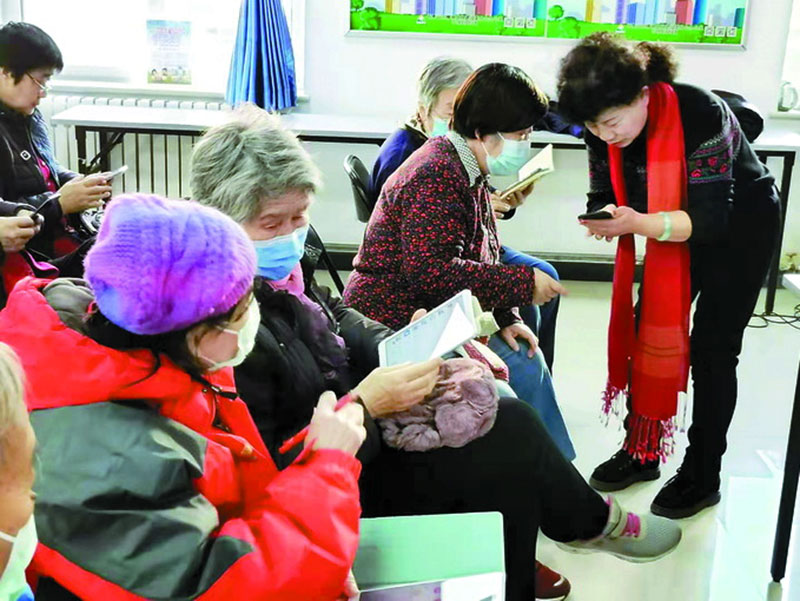
One of the volunteers, Yang Xu, a sophomore with the university's artificial intelligence department, said: "They (seniors) forget quickly and ask the same question repeatedly. Those coming to us are usually open-minded and eager to learn. New technology should provide them with access, rather than a barrier, to a better life."
Xu has become quite close with Qu, whom he calls "Grandma Qu". "After a while, we developed a bond and she shares her wisdom with me," he said.
During a two-hour class, Xu even gave her a massage to alleviate back pain after Qu had remained sitting for a long time.
Shen Hongkun, a junior student at the university's management school who joined the program as a freshman, said the university's neighborhood community is home to 4,000 retirees, many of whom have children living elsewhere in China or overseas.
"Our services, as well as the companionship, bring positive changes to seniors' lives. We feel good about helping them," Shen said.
However, he added that the program can only reach a small number of seniors, who also need care and support from society as a whole.
"Seniors could struggle to cope with daily 'smart' routines that are second nature to younger people," Shen said, suggesting that services tailored for the elderly should be launched at public facilities.
He added that smartphone and app developers should also develop functions that seniors can understand and use.
Liu Xiumei, 70, a retiree from the university, said she could not agree more.
She joined the program last year, largely as a result of the pandemic emerging.
"I didn't know how to scan a health QR code, so I could not use buses or visit a shopping center," she said.
Previously, she used her smartphone mainly to chat with friends on WeChat or to watch short videos.
"With the arrival of the pandemic, a smartphone has become an essential part of life, although I initially found it quite hard to master all the functions," Liu Xiumei said.
Now, she is happy with her phone, and is learning to edit videos and navigate with GPS.
"The outbreak is under control and I'm planning to travel in the spring," she added.






- Debt-ridden children's hospital gains strong public support, but future still uncertain
- China hands over 17 Filipino sailors from shipwreck to Philippines
- Topography, extreme rainfall causes of Guizhou landslide, report says
- Various activities held to welcome upcoming Laba Festival
- Beijing plans further expansion of its world-class metro network
- Xi leads China's diplomacy to usher in new chapter in turbulent world