



China's carbon pledge drives progress









2060 net-zero vow nudges other nations to accelerate climate efforts, experts say
China's pledge to be carbon neutral by 2060 sets an example for other countries, and its energy policies will play a central role in achieving that goal, said energy experts.
"The carbon neutral pledge has really done a lot to inject new momentum into the global climate negotiations," said Barbara Finemore, founder of the China Program of Natural Resources Defense Council, a New York-based environmental advocacy group.
"Shortly after China's announcement, we had Japan and South Korea make their own climate neutral pledges, and just recently we understand that India is considering adopting its own 2050 net-zero pledge, which probably wouldn't have happened if it hadn't been for China," she said at a recent webinar hosted by the US-China Series, an organization that brings together academics and policymakers.
China pledged to have carbon dioxide emissions peak before 2030 and achieve carbon neutrality before 2060 during a United Nations General Assembly meeting in September 2020.
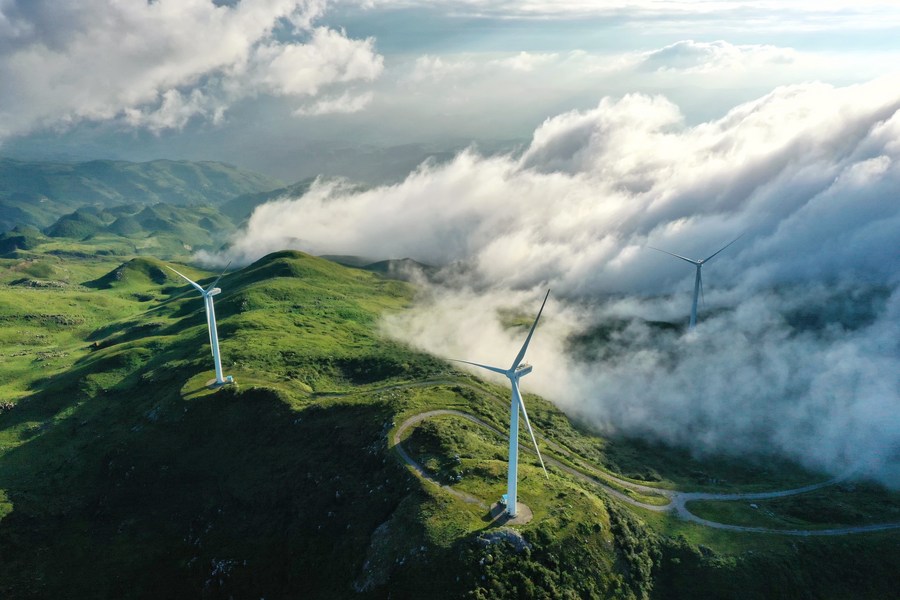
In December, China announced new targets to increase the share of non-fossil fuels in its primary energy consumption to 25 percent by 2030 and boost its installed capacity of wind and solar power to more than 1,200 gigawatts by that year.
"Peak carbon emissions by 2030 was really a big deal; carbon neutrality by 2060 was a big pledge. China is stepping out and taking a global leadership role and getting ahead of the United States," said Michal Meidan, director of the China Energy Programme at the Oxford Institute for Energy Studies.
She said one of the big drivers behind the 2060 pledge is "an industrial opportunity with the energy transition". There's a "threat" from a European Union carbon border adjustment mechanism, which would impose a charge on imports into the EU of certain raw materials from "less climate-ambitious countries", she added.
"If the Chinese industrial structure is not fit for purpose in an increasingly carbon conscious world, then the entire Chinese economic model loses out," said Meidan.
Innovation power
As to energy transition technologies, Finemore said China already has a positive track record of innovation in wind, solar and electric-vehicle technologies.
"These core technologies were initially acquired from abroad, but what China has excelled in is developing economies of scale and manufacturing innovation that has brought down the cost of these technologies to the point where they are close to being competitive with their fossil fuel alternatives," she said.
"I was really interested to see that recently China has been working, as has the EU and the US, on developing the next generation of solar cells-the perovskite solar cells that could really transform the industry," said Finemore.
A perovskite is a type of solar cell that usually has a hybrid organic-inorganic lead or tin halide-based material as the light-harvesting active layer. The materials involved are inexpensive to produce.
Such solar cells have been mostly in research labs, but China has recently opened a production facility that will realize "economies of scale and manufacturing innovation on that very promising new technology", Finemore said.
As the leading producer of hydrogen, China has already brought down the cost of those alkaline electrolyzers by 80 percent, and it could do the same for the polymer electrolyte membrane electrolyzer, if it gets access or develops its own technologies, said Finemore, using the electrolyzer example, a system that uses electricity to produce hydrogen.
The tensions between the US and China and the export restrictions on certain technologies by the US serve as a "wake-up call" for China to be more self-reliant, as reflected in the 14th Five-Year Plan (2021-25), said Finemore.
"China includes a target to increase its spending on R&D, but also to increase the proportion of that dedicated to basic research," she said. "Even more, it's talking about reorienting its entire system of research labs.
"China's also focusing on having its research institutes work more closely with industry. They're giving tax breaks to industry for conducting basic research with research institutes.
"It's a race right now, and it's going to be very interesting to see who comes out ahead and also what opportunities there are for cooperation in ways that benefit different countries," said Finemore.








