



China looks to deeper waters for wind power in pursuit of carbon neutrality









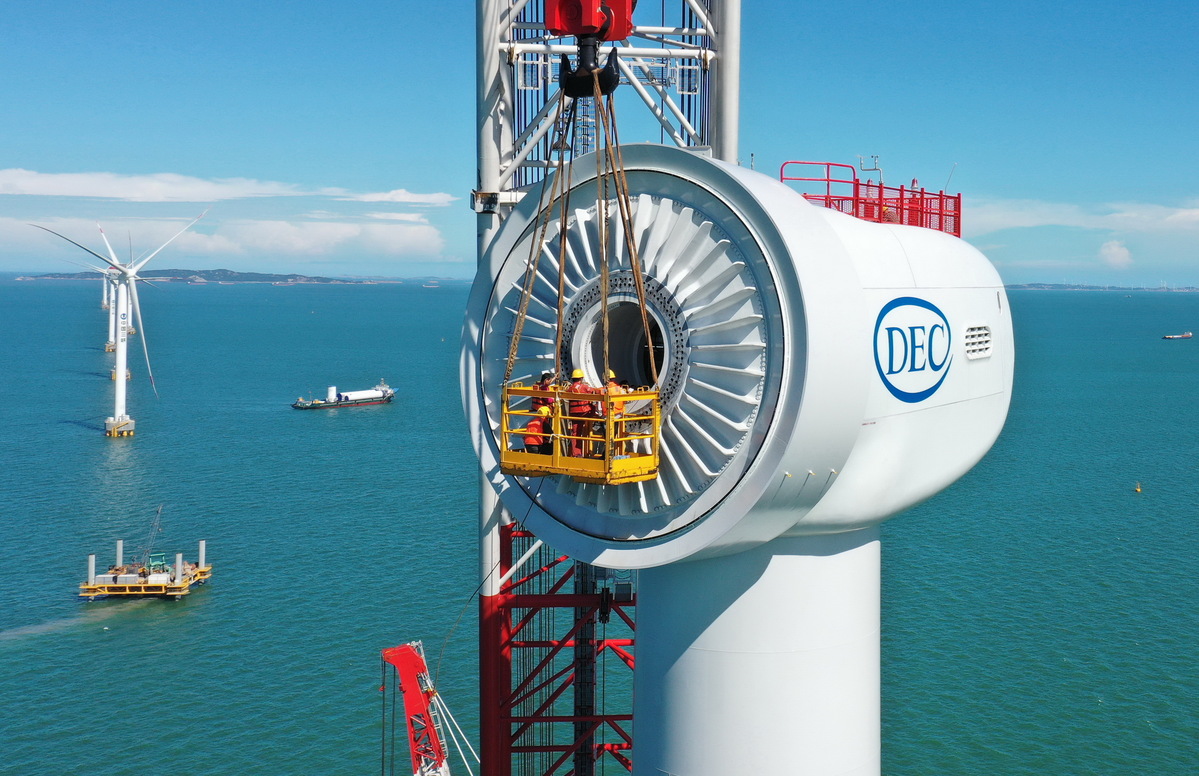
FUZHOU -- As China's push to reach carbon neutrality by 2060 draws increased attention toward wind power, experts say moving wind farms to deeper waters could eliminate some of the challenges to offshore wind power and help expand the fleet of turbines.
A new plant operated by LM Wind Power, a Danish wind turbine blade manufacturer, last Friday began manufacturing 107-meter blades -- among the longest blades worldwide -- in East China's Fujian province. The blades are expected to roll off the production line this October and will add to the variety of Chinese-made wind turbine components available for wind farms at home and abroad.
The plant is situated at the 1,000-mu (about 66.7 hectares) offshore wind power industrial park run by the Fujian division of the China Three Gorges Corporation, the developer of China's largest hydropower project, which broke ground in 1994 in Central China's Hubei province.
Before LM, domestic companies like Xinjiang Goldwind Science & Technology Co Ltd and Dongfang Electric Corporation Limited had settled in the industrial park and produced electrical generators, blades and other components.
The bay next to the industrial park houses 59 wind turbines with a total installed capacity of over 357.4 megawatts and annual electricity output of 1.4 billion kWh.
Offshore wind farms of a similar size and scale are now prevalent in China's coastal provinces. The country's total installed capacity of offshore wind power was 9 gigawatts by the end of 2020, ranking second globally.
China's goals of peaking carbon emissions by 2030 and achieving carbon neutrality by 2060 demand greater reliance on clean energy sources like photovoltaic power and wind power, experts say, and offshore wind power is gaining particular traction as the technologies mature.
"Offshore wind power is ready for scale development in China, with the help of supportive policies and costs being driven down by an improving domestic industrial chain," said Wang Zhongyao, vice president of China Renewable Energy Engineering Institute, at a clean energy summit in Fujian's Zhangzhou city in June.
Official data shows that China's new offshore wind capacity was 3.06 gigawatts in 2020, approximately half the global total. However, costs are still too hefty and near-shore resources are too limited for offshore wind to become a more prominent contributor to China's energy structure.
Close to shore, environmental red lines have been drawn for wind farms for the protection of mangroves, coral reefs, important estuaries, tidal flats, endangered species, and fishery resources. Bird migration routes are void of wind turbines as mandated by the State Oceanic Administration.
The future of offshore wind farms, experts suggest, lies in waters farther into the ocean with depths of over 50 meters or over 70 kilometers off the coast.
Offshore wind power is expected to account for 10 percent of total power generation in 2050, and 70 percent of the technical potential is in deeper waters suited to wind farms floating on the ocean surface rather than digging into the ocean bed, said Dolf Gielen, director of the International Renewable Energy Agency Innovation and Technology Center.
Investments are already flowing in that direction. Zhangzhou, for instance, is building a world-class offshore wind power industrial base in deeper waters. The total installed capacity of potential wind farms in the waters near the city is as high as 50 gigawatts.
"We invested another 10 billion yuan ($1.5 billion) in the production of hydrogen from seawater," said Jin Yunshan, senior vice-president of a Guangdong-based clean energy firm.
Power generated from wind turbines in deeper waters can be used to produce hydrogen for petrochemical enterprises nearby, and can help local communities pursue a zero-carbon economy, Jin added.
"With future breakthroughs in large-capacity wind turbines and floating foundations, China's offshore wind power will venture farther out to sea and become a significant driver to realize carbon goals," said Wang.


















