



Beijing quick to help reduce regional poverty









Priority treatment
Early last month, Luo Zhaohui, head of CIDCA, wrote in a signed article that China has always given priority in its international aid programs to improving people's livelihoods-especially eliminating hunger and poverty.
"China's foreign aid is conducted in ways that are similar to friends helping each other. It not only helps beneficiary countries improve people's livelihoods and promote economic growth, but also creates a good external environment for China's own development and the happiness of its people," he wrote.
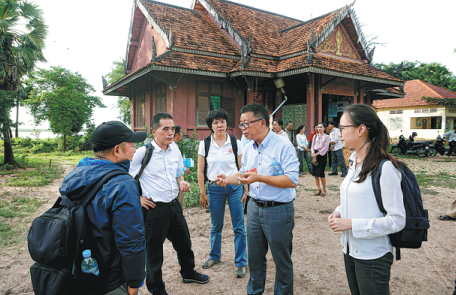
Lin, the project official, said the Chinese experts had to start from scratch when they arrived in Svay Ampear, which is about 50 kilometers from Phnom Penh, the Cambodian capital.
The fact that many villagers do not have their own farmland was the biggest obstacle to poverty alleviation, and the project officials had to match their expertise to meet local conditions.
The high cost of electricity, with private power companies charging as much as $200 to connect each household, is another hurdle to improving livelihoods. According to the World Bank, 9.1 percent of the rural population in Cambodia did not have access to electricity in 2019.
Lin said: "There were no statistics for the number of people or households in the village. We planned to divert water from the Mekong River to supply tap water to the households, but there were no data or observation locations to provide any clues to the water quality."
Impoverished farmers such as Mao Tith were the focus of attention for the project officials, who decided to help the 75-year-old and his family relocate to a new home.
Mao managed to raise $350, while the project funded another $830 to rebuild his home, a house made from a metal framework and which had a toilet made of concrete. The project officials helped him grow pepper on a patch of land he borrowed from a relative. The project also allowed him to raise a calf.
Yuan Gang, a leading Chinese official for the project, said special attention was paid to letting poor households come up with their own initiatives to alleviate poverty.
For households without farmland, the experts helped them grow vegetables in pots, reducing their annual spending by $180 to $250. For those with farmland, a program was launched to help farmers grow mushrooms.
The project also provided 20 calves for the village and encouraged residents to share them as a source of income. A factory producing detergents was set up to offer job opportunities, with the farmers becoming shareholders.
Yuan said: "We paid special attention to getting poor farmers involved during implementation of the project. Their views were respected and their advice was adopted."








