Taiyuan's Taoist temple Chunyang Palace one of many historic sites









The Shanxi provincial capital of Taiyuan is a city with so many ancient structures that even a casual stroll on the streets can lead visitors to something pleasantly unexpected: an old residence, a garden or a monument, for instance, with great historical and cultural values.
One such site is a Taoist temple called Chunyang Palace, nestled near the busy commercial district of Wuyi Square.
The temple, which is also called Lyuzu Temple, was first built during the Yuan Dynasty (1271-1368) to worship Lyu Chunyang, or Lyu Dongbin, one of the prominent figures in the religion of Taoism.
Massive renovations took place during the Ming (1368-1644) and Qing (1644-1911) dynasties, so most of the structures in the temple are remnants from the two periods.
Small as it is, Chunyang Palace is regularly praised by tourists and researchers for its ingenious layout. It is a five-courtyard complex combining temple buildings and gardens.
Lyuzu Hall is the main hall of Chunyang Palace. It is located between the second and third courtyards. The architecture style of the courtyards is unique as it is composed of classical gardening elements such as halls, pavilions, rockeries and corridors, which are rarely seen in other Chinese temples.
Lyuzu Hall also features a huge wall painting called Eight Immortals Crossing the Sea, which portrays a household Taoist legend in China. Lyu Dongbin was one of the eight immortals after his deification.
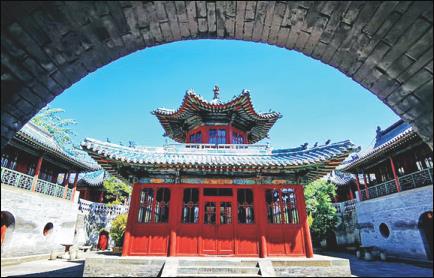
Another unique characteristic of the temple is the pavilion-styled hall in the rear courtyard, which can be accessed through an arched gate. It sits on a broad, square foundation featuring eight cave rooms. Cave rooms are the common dwellings on the Loess Plateau, which covers Shanxi and Shaanxi provinces, as well as the neighboring regions.
The hall is connected to its surrounding buildings with bridges, and researchers said such a design is very popular in southern China's classical gardens but uncommon in temples.
Today's Chunyang Palace also serves as a museum. On display in the temple are stone carving works created during various historical periods including the Han (206 BC-AD 220), Wei (220-265) and Tang (618-907) dynasties.
One of the most precious exhibits are the Han Dynasty stone-carving works unearthed in Shanxi's Lishi county. Portraying life from some 2,000 years ago, the works are deemed as highly valuable by history and art researchers.
Peng Ke'er contributed to this story.