



Can the big cats survive the human assault?









Editor's note: With the Year of the Tiger a week away, two experts and a senior editor with China Daily share their views on the cultural significance of the big cat and the urgent need to protect the wild tiger and its habitats:
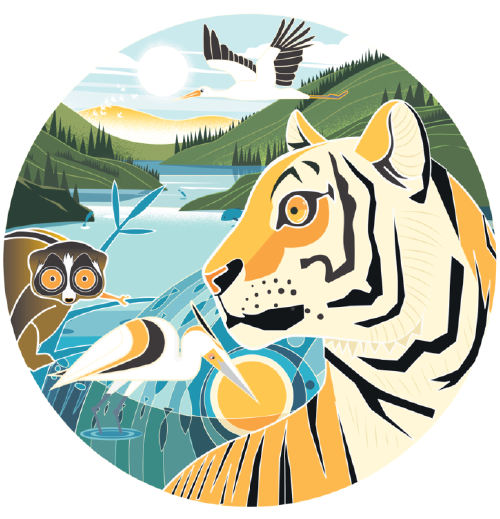
It is admired, respected, feared and hated in equal measure depending on where you live and what your livelihood is. It also inspires, has an aura of its own, is the subject of myths and legends, and symbolizes strength and power. It is even depicted as a vessel of powerful deities and worshipped. It has adorned the emblems of kings and emperors. Indeed, it is a royal beast.
It is known for its adaptability, for it has survived, and once thrived, in terrains as different as the hot and humid, almost non-navigable mangroves of the Gangetic Delta called the Sunderbans in India and Bangladesh, the tropical and subtropical forests, moist evergreen forests and tropical dry forests in India, the temperate forests up to an altitude of 4,000 meters in Bhutan, and the freezing temperate mixed forests in Russia, Northeast China and the Korean Peninsula.
Yet the big cat is in danger, in danger of extinction, because the very people who admire and respect it also love and hate it. They hate it because they believe it is encroaching upon their land, instead of the other way round, and attacks and kills their cattle, even fellow folk. They love it, because they can hunt it and earn precious money by selling its skin, bones, teeth, organs and other parts. The bulk of the profit goes to middlemen and end suppliers, though.
So with the "Year of the Tiger" a week away, it's an opportune moment to consider the plight of the big cats, and real action to provide them and their habitats foolproof protection.
After more than 100 years of continuous decline, the number of wild tigers increased for the first time in 2015. But that is the only bit of good news, for the species is threatened in all its habitats across South Asia, Southeast Asia and East Asia. The fact that the number of wild tigers has declined drastically from more than 100,000 at the turn of the last century to just about 3,900 today is enough reason for us to mourn.
The tiger no longer burns bright in "the forests of the night", as William Blake conceived it in his eponymous poem The Tyger. It no longer seems that an "immortal hand or eye" framed its "fearful symmetry". Rather it appears "he who made the Lamb" favored such innocent, cuddly creatures to survive the wrath of humans despite falling under their knives in millions each year, not the one that sits atop the food chain.
Consider this. With 2,226 wild tigers, India is home to the largest tiger population in the world-about 60 percent of the global total. But in 2021 alone, more than 120 tiger deaths were reported in the country, with most of the animals falling victim to poaching, with a few killed in man-animal conflicts.
Tiger habitats across countries are shrinking at an alarming pace, mainly due to the rising demand for forest products, especially timber, cultivable land, and mining. In other words, greed and development. And shrinking habitats mean more conflicts among tigers, because normally a tiger's range covers 100 square kilometers, declining prey populations and frequent human-tiger encounters.
The tiger depends on the forest, they say, and the forest depends on the tiger. So with the tigers gone, the forests too would go, sooner rather than later.
The tiger has survived for thousands of years, the last 100-odd years against all odds. But perhaps it cannot withstand the human onslaught anymore, and could soon become extinct in the wild.
In fact, the world has already lost the Bali, Javan and Caspian tigers, the first of these in the 1950s, the last two in the 1970s. The Bali and Javan tigers were not only hunted to extinction but also their natural habitats were turned into cultivable land or used for infrastructure.
If governments and political leaders do not stop paying lip service and instead take serious measures to conserve the natural habitats of tigers and end the menace of poaching, the tiger could soon be in the company of the only mythical beast in the Chinese Zodiac-the dragon.
The Year of the Tiger would still be celebrated but kids won't be able to admire the beauty and power of a tiger in real flesh and blood in its natural habitat.

The opinions expressed here are those of the writer and do not necessarily represent the views of China Daily and China Daily website.
If you have a specific expertise, or would like to share your thought about our stories, then send us your writings at opinion@chinadaily.com.cn, and comment@chinadaily.com.cn.






