



Saving species through sound









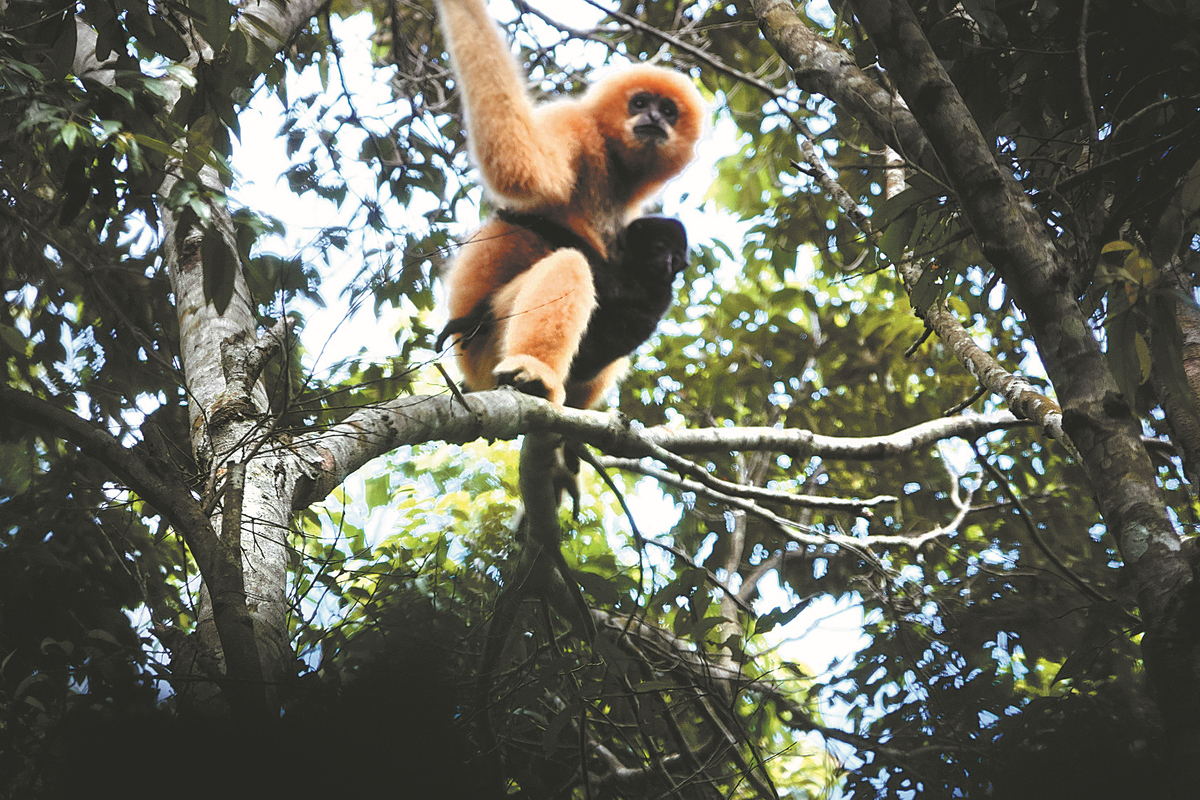
Acoustic monitoring helps Hainan conservationists track rare gibbons
Daily life for Hainan gibbons in the hinterlands of the province's tropical rainforests begins at around 6 am, when the male heads of the five remaining families begin the high, melodious whistling that echoes through the thick, cloud-shrouded forests to reach villagers down in the valleys some 800 to 1,200 meters below.
"The whistling, which zoologists interpret as a way for each family to mark its territory, becomes richer and more harmonious as the matriarchs and other family members join the chorus. It's the most moving example of group singing displayed by the 20 remaining gibbon species in the world," said Chen Qing, a woodcutter-turned ranger who recently retired after working for more than 37 years at the Bawangling National Nature Reserve in southwestern Hainan Island.
Established in 1988 and covering about 300 square kilometers, Bawangling is the only habitat of the Hainan gibbon, or nomascus hainanus, to give the species its scientific name.
The world's rarest primate currently has a population of just 35, split into five families.
Bawangling forms a key portion of the Hainan Tropical Rainforest National Park, the country's best preserved tropical rainforest, which covers 4,269 square kilometers, or one-seventh of the island. More than 95 percent of the park is virgin forest and is home to 3,653 species of wild vascular plants and 540 species of terrestrial vertebrates, according to the park's administration.
The charming sounds made by the gibbons are currently being recorded and transmitted in real time to a cloud-storage terminal by 50 high-tech devices mounted in the trees. The Hainan National Park Research Institute and the International Union for Conservation of Nature launched the acoustic database project in January last year, with the aim of better protecting the park's flagship species by using the data to interpret their language, according to Wang Jichao, leader of the project and vice-dean of the life science college at Hainan Normal University.
"The devices are based on Huawei's Tech4Nature technology and are capable of automatically recognizing the sound of Hainan gibbons. They self-activate and start recording when one of the gibbons makes a sound," he said.
The Huawei system is being used in 30 national parks around the world and has won awards from the United Nations for its outstanding contribution to safeguarding nature, according to media reports.


- Xinjiang guide forms deep bonds with Taiwan visitors
- BLCU aims to expand international student enrolment
- Digital reading boom draws more Chinese into books
- Taiwan business groups urge DPP to respond to mainland's exchange policies
- Hong Kong's Wang Fuk Court residents return to fire-ravaged units in batches for belongings
- Equal protection principle boosts IP judicial system


