


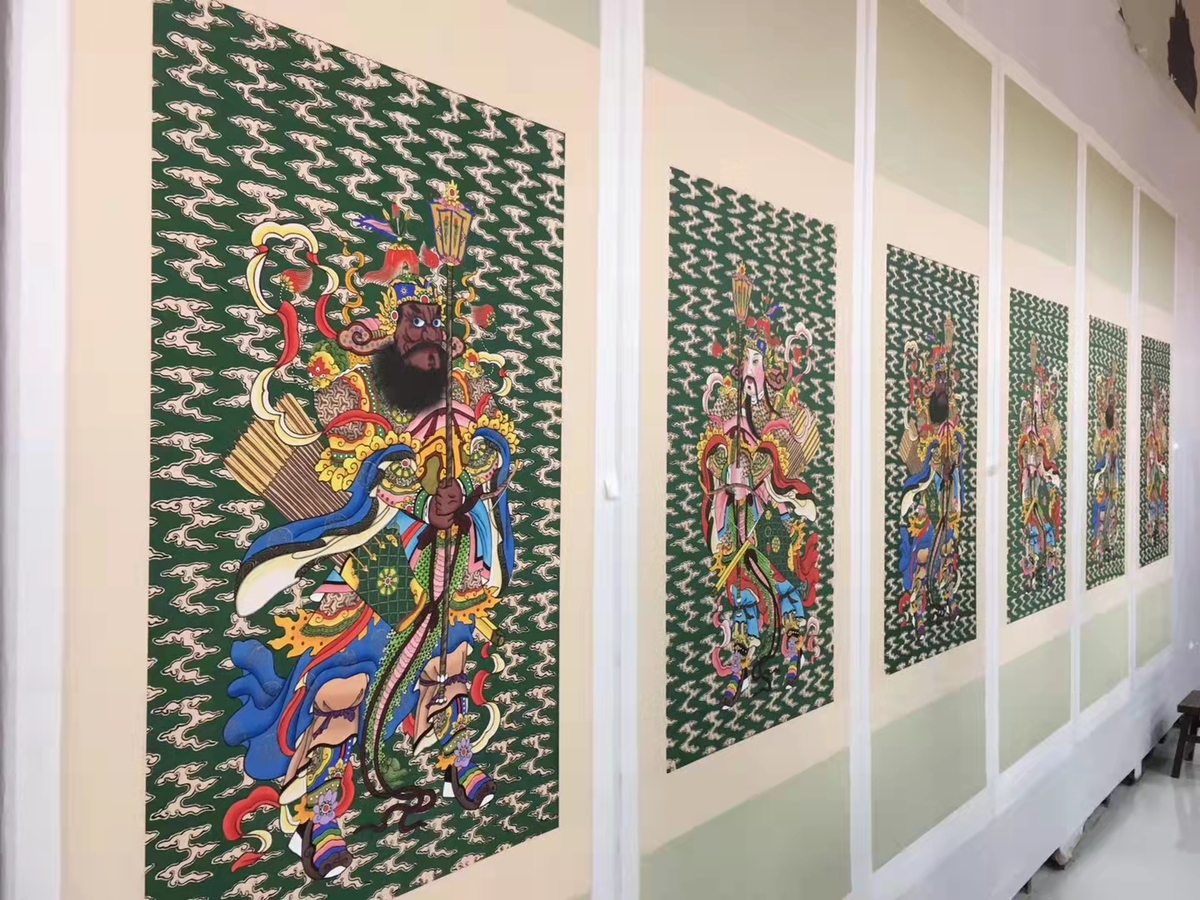
It is common for Wang to spend months creating a single wooden plate, made of pear tree. The lumber has to be stored and dried for three years before it can be used.
After the plate is complete, the printing process itself can take up to a month for the picture to be finished and mounted.
Yangliuqing woodblock prints have abundant themes, which are inspired by literature, folk legends and myths, among others. However, the most recognizable are usually of auspicious symbols for the Chinese New Year.
According to Li Zhenyu, a fine arts professor from Sichuan University, Chinese New Year paintings can be dated back to the Han Dynasty (206 BC-AD 220) when a pair of images depicting two deities appeared on doors to ward off evil spirits. The variation in themes and imagery grew more abundant when the secular lives of people during the Tang (618-907) and Song (960-1279) dynasties fueled the influence of Buddhist art on the craft.
During the Ming Dynasty (1368-1644), when colorful woodblock prints were commonly used in people’s daily lives, the development of New Year paintings was also greatly propelled.
Historical records show that the Yangliuqing town and its surrounding villages were full of picture workshops during the Qing Dynasty (1644-1911).
However, the early 20th century saw the arrival of the modern offset printing technique in China.
The most famous new year picture workshop in Yangliuqing town, Dai Lianzeng, which once served the imperial palace in Beijing, finally closed in the 1930s after 19 generations.
“Without the country’s effort to save the craft of woodblock printing in the 1950s,” Wang recalls, “it would have been dead.”
New Year painting, is, perhaps, a nostalgia that belongs to all Chinese people.





